
 2 months ago
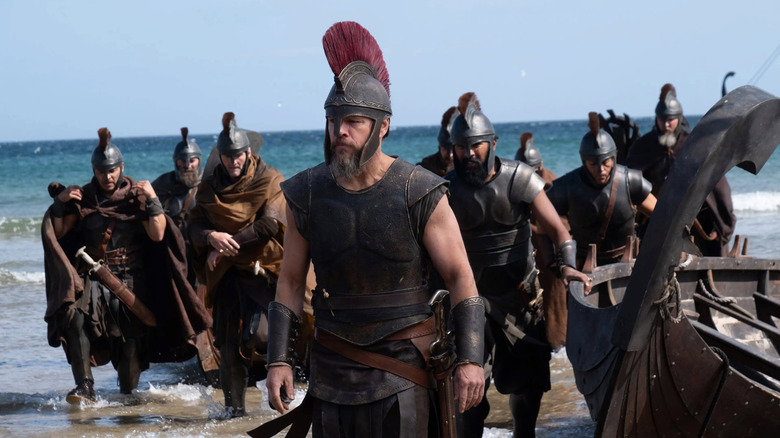
Universal Pictures
Defy the gods ... at your own peril. This article contains major spoilers for "The Odyssey."
Despite all the pre-release controversy swirling around Christopher Nolan's "The Odyssey," this movie was never going to be exactly like the original poem — that's what it means to be an adaptation, after all. But now that we've sighted land on the horizon and audiences are finally getting a chance to check out the epic blockbuster for themselves, one specific detail may come as a surprise. It feels like every other major topic has become a talking point over the last several months, most recently the debate surrounding the modern dialogue used throughout the movie, but it's time to talk about the biggest one of them all: the gods.
Anybody with even a passing familiarity with "The Odyssey" should be aware of the fact that Odysseus' (played by Matt Damon in the film) arduous journey back home to Ithaca is rife with obstacles and setbacks — some of his own doing, some involving unforeseen threats, and others that are decidedly more supernatural. That last part tends to stick out in the minds of most readers, from constant invocations of Zeus to raging seas representing the wrath of Poseidon to the direct interference of gods like Calypso and Athena. For fans curious about how the director of grounded movies like "The Dark Knight," "Inception," and "Oppenheimer" would tackle such larger-than-life subject matter, well, the answer isn't terribly surprising.
For fans of the original, Nolan's toned-down approach to the gods of this story may feel like a letdown. Yes, the gods are present and accounted for throughout his retelling of "The Odyssey" ... but only in a (relatively) "realistic" way. Expect opinions to be split right down the middle on whether this works.
How prevalent are the Greek gods in Christopher Nolan's The Odyssey?
Melinda Sue Gordon/Universal Pictures
To his credit, Christopher Nolan makes his intentions loud and clear with that opening title card: "In a time of apparent magic..." Of course the filmmaker who insisted on dreams feeling as normal as possible in "Inception," a Batman with a perfectly explicable origin for all his fancy toys, and even a scientifically accurate black hole in "Interstellar" would take a similar route with "The Odyssey." Unsurprisingly, his handling of the gods in "The Odyssey" is more or less exactly what we'd expect from him.
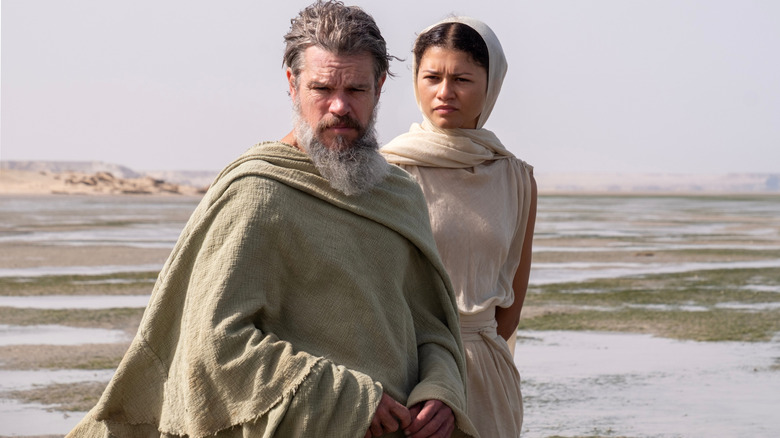
While the original story kicks off with Athena interceding for Odysseus' family back home and urging them to seek news of the missing patriarch (albeit in disguise), this adaptation takes a much more hands-off approach. While the gods are frequently spoken of in hushed tones and fearful whispers, the humans of the story are frequently left to make their own decisions and decide their own fates — or so they think, at least. Athena does appear (played by Zendaya), but only as a specter visible exclusively to Odysseus. Is she in his mind? A projection of his own guilt? Or is this more of that apparent magic, a supernatural act meant to guide him on his long and winding journey?
This ambiguity extends to many other supernatural elements. The raging sea certainly feels like cosmic judgment on Odysseus and his men after they blind the god's Cyclops son, Polyphemus (Bill Irwin), but is that just a storm interpreted to be something more? The sin of eating the sun god's cattle haunts the starving men, but Helios himself is nowhere to be seen. Only Calypso (Charlize Theron) is treated as a full-fledged character, but only Odysseus ever interacts with her.
Why Christopher Nolan's realistic approach to The Odyssey fits his interpretation of the story
Melinda Sue Gordon/Universal Pictures
While this may come as a disappointment to purists, one could argue that this more realistic take on Homer's world-famous "Odyssey" perfectly fits what Christopher Nolan is trying to accomplish here. Sure, some may have preferred another director more willing to embrace the fantastical — that's certainly how we ended up with something like Zack Snyder's "300," after all. But that tension between Nolan's usual MO and the heightened aspects intrinsic to this saga only makes his choice to adapt this story all the more fascinating. And, in fact, he manages to make their roles in the plot feel vital and thematically sound ... even if nobody's shooting lightning bolts from their fingertips.
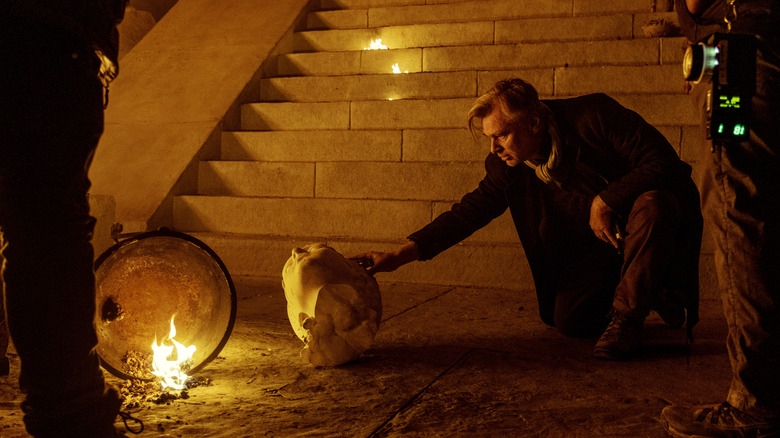
Because Nolan's interests lie in the human moments between the mythmaking. The moment that best encapsulates this idea comes towards the end of "The Odyssey," when Odysseus' ongoing narration catches up to events from a decade ago in Troy. When he and his fellow soldiers infiltrate the city inside the Trojan Horse and set everything to the torch, Odysseus experiences a vision (or perhaps perceives the reality) of Athena's head being struck clean off amid the chaos — a damning statement of humanity's corruption of the pure and innocent.
Had this movie opted for a more literal, blunt-force approach to the gods and deities of the story, much of the nuance of this adaptation would be lost. Instead, "The Odyssey" emphasizes humanity in all its flaws and imperfections. And when Odysseus muses on whether all his mistakes will be "forgotten" in the end, we viewers know the truth. Defy the gods, indeed.
"The Odyssey" is now playing in theaters.



 English (US) ·
  Indonesian (ID) ·