
 3 months ago
Paramount
Welcome to Trekspertise, a series where we break down the technology, history, details, and decisions that make the Star Trek universe so complex — and so fun.
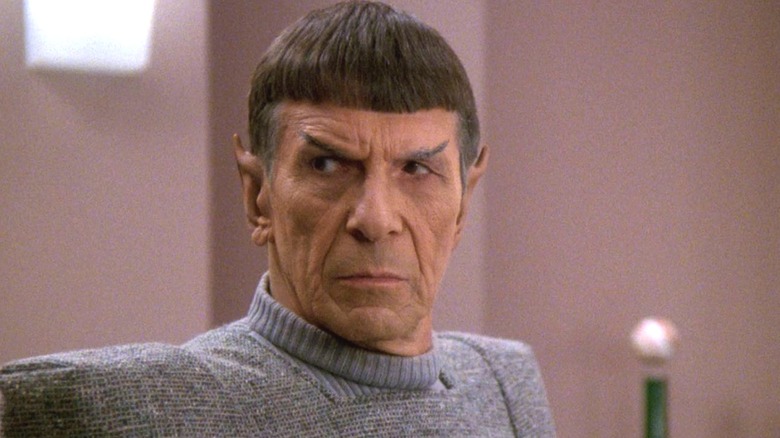
On a philosophical level, the Vulcans and the Romulans couldn't be more different. As we have previously talked about on /Film, Vulcans, as a culture, have long adhered to an ethos of emotionless logic. Vulcans were once a violent, warlike people who almost drove themselves to nuclear annihilation. Luckily, a Messianic figure named Surak arose during a turbulent time and proposed the excision of emotions and the embrace of logic as a better way forward. Surak's message caught on, and the so-named "Time of Awakening" began. The Vulcans have been devoted to logic ever since. As stated in the "Star Trek: Enterprise" episode "The Forge," this happened around 300 AD on Earth.
Romulans, meanwhile, are the masters of an enormous, militant Star Empire, ruled from the twin planets of Romulus and Remus. Romulans believe in military power, and the infallibility of the state. They are xenophobes, and have employed a vast and blindingly complex network of spies throughout the galaxy and within their own ranks. They are secretive to the point of it becoming their driving ethos. As a Romulan once stated on "Star Trek: Picard," you could put the word "secret" in front of any other Romulan word, and it would still be accurate.
As many Trekkies will be able to tell you, the Vulcans and the Romulans are, in terms of their species, close cousins. Vulcans and Romulans once hailed from the same planet, and only separated as cultures about 2,000 years before humans met Romulans for the first time. Those 2,000 years were rough for both worlds, and some have sought to reunify them.
Vulcans and Romulans used to live on the same planet
Paramount
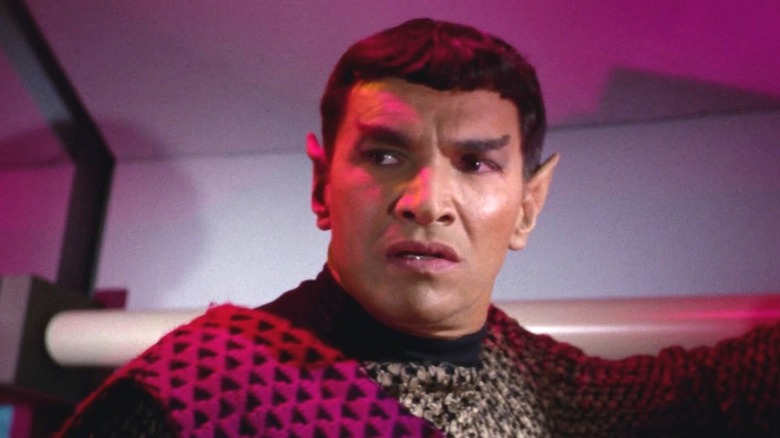
Trekkies first saw Romulans in the original "Star Trek" episode "Balance of Terror," wherein it is stated that humans had never seen Romulans face-to-face before, and wherein the Enterprise has a tense, weapons-hot standoff with an O.G. Romulan Warbird. In that episode, we see that Romulans have the same pointed ears and same angled eyebrows as Vulcans. It's suggested that Romulans are biological cousins of Vulcans.
In later episodes, these notions were filled out by "Star Trek" writers. In the "Star Trek: The Next Generation" episode "Unification," it's stated that several sects of people left the Vulcan homeworld during the Time of Awakening, rejecting Surak's message of emotionless logic. One of those sects settled on Romulus and founded the Romulan Star Empire. It seems, however, that there was always a note of lingering resentment between the two species. In the "Star Trek: Voyager" episode "Death Wish," Q (John De Lancie) alludes to a war between the Vulcans and the Romulans that lasted a hundred years.
Something that "Star Trek" has never quite been clear about is when Vulcans and Romulans became separate species. It takes millions of years for a humanoid species to evolve, so it's unlikely that the Romulans would develop cranial ridges, etc. in only the 2,000 or so years since the Age of Awakening. Even the "Star Trek" website is unclear on the idea, positing that Romulans evolved alongside Vulcans during the planet's more violent period, and were already a separate species long before the Age of Awakening ... but no one knows exactly when that occurred.
After millennia of war and resentment, however, an underground movement eventually arose to bring Vulcans and Romulans back together.
There have been efforts (by Spock) to reunite the Vulcan and Romulan people
Paramount
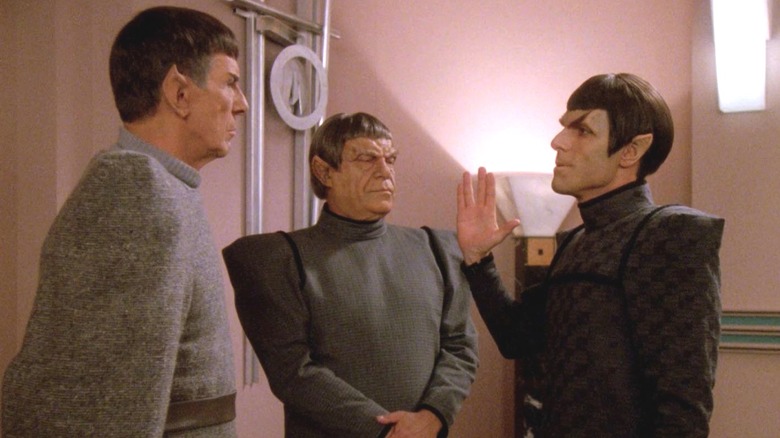
In the two-part "Star Trek: The Next Generation" episode "Unification," it is stated that Spock (Leonard Nimoy), initally banned from "Next Generation," had been living among Romulans for many years, hidden by a secret Romulan resistance movement, attempting to negotiate a peace between Romulans and Vulcans. This was a dangerous endeavor, as any Romulan who expressed interest in Vulcan philosophy was declared an enemy of the state. Spock also had to be cautious about everyone in the resistance, as it was wholly probable that it had been infiltrated by Romulan government spies. Of course, in "Unification," there is a notable betrayal by an unexpected turncoat. The two-parter is pretty darn good.
At the end of the two-part episode, it appears that unification is still a distant dream, but Spock, being very long-lived (Vulcans can live for over two centuries), decides to stay on Romulus to keep the dream alive. The efforts to reunify Vulcan and Romulus had already been churning for a century (as mentioned in the "Star Trek: Enterprise" episode "Kir'Shara"), so what are a few hundred more years?
Eventually, Vulcan and Romulus did reunite, as detailed in "Star Trek: Picard" and "Star Trek: Discovery" (set in the late 24th and late 32nd centuries, respectively). At some point between those periods, Vulcans and Romulans (who each suffered planetary cataclysms of their own) settled on the Vulcan homeworld, which they renamed Ni'Var. It was said that Spock, while dead, left a legacy of unification dreams that eventually inspired both species to come together, so unification was finally achieved. Many of the people of the 31st century were of blended Vulcan/Romulan heritage.
Unity has always driven the utopia of "Star Trek," so unification isn't just some random piece of storytelling politics within a grand sci-fi fiction. It's also an example of overriding hope.



 English (US) ·
  Indonesian (ID) ·