
 2 months ago
20th Century Fox
Author Michael Crichton began dabbling in movies as early as 1973 when he penned the screenplay for a little-seen movie called "Extreme Close-Up," a thriller about voyeurism. That same year, though, he also had a massive breakthrough when he wrote and directed the killer android movie "Westworld," a multimillion-dollar hit. That film was about human robots that had been programmed to entertain people at a futuristic history-themed amusement park, but which went haywire and started killing the guests. Given that Crichton would go on to write "Jurassic Park" in 1990, it's clear that killer amusement parks were a preferred motif of his.
Crichton wrote and directed four additional films after "Westworld" — "Coma," "The First Great Train Robbery," "Looker," and the cheesy "Runaway" — and directed one more, "Physical Evidence," before getting out of the directorial chain and heading back to his typewriter. This, of course, wasn't any sign of reduced success for the author; he continued to churn out blockbuster screenplays and bestselling novels until his death in 2008.
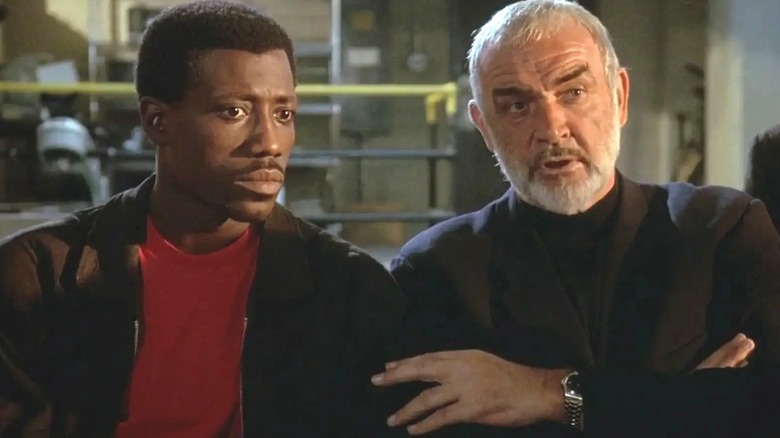
In 1993, the same year Crichton wrote the screenplay for Steven Spielberg's crackerjack adaptation of "Jurassic Park," he also had a major hit in the lesser-known movie "Rising Sun," directed by Philip Kaufman. Crichton adapted "Rising Sun" from his own 1992 novel, and it had a crackjerjack cast that included Wesley Snipes, Sean Connery, Harvey Keitel, Cary-Hiroyuki Tagawa, Steve Buscemi, and Tia Carrere, fresh off her fame from "Wayne's World."
"Rising Sun" is a murder mystery set in Los Angeles, wherein Snipes and Connery investigate the death of a sex worker in the newly opened building of a Japanese business consortium. The $40 million film was a huge success, making over $107 million at the box office.
This, despite not being a very good movie.
Rising Sun was a huge hit the same year as Jurassic Park
20th Century Fox
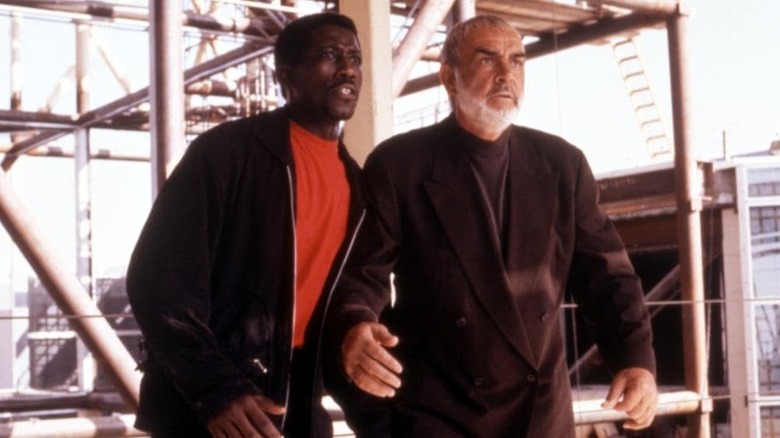
It should be noted that (as mentioned in Michael Crichton's obituary), the novel "Rising Sun" was under a lot of scrutiny back in 1992 for its depiction of the Japanese community and the cutthroat nature of Japanese businesses. Crichton was accused of racism. Having seen the movie, it's not exactly culturally sensitive. Sean Connery plays an expert on Japanese affairs and has speeches about the way the "Japanese mind" functions. Japanese people are, for the most part, relegated to supporting roles, and Japanese culture is certainly exoticized. It's not an outwardly hateful film, but "Rising Sun" is certainly dated in its attitudes and makes racist assumptions.
"Rising Sun" was perhaps not as widely beloved as "Jurassic Park" because it was an R-rated thriller about the ins and outs of rough sex. Its central victim (Tatjana Patitz) is killed while having sex on the boardroom table of a new Japanese business building, and a Los Angeles cop (Harvey Keitel) is called in to investigate. The Japanese business overlords are nervous about how it might look with the LAPD sniffing around their building, so they hire Smith and Connor (Snipes and Connery) as specialists in Japanese affairs. Well, Connor does most of the investigating, while Smith looks on and absorbs his oh-so-salient wisdom.
Tia Carrere plays the film's computer expert, Jingo Asakuma, and a large portion of the plot of "Rising Sun" hinges on high-tech footage of the murder that has been skillfully erased to keep the killer's face obscured. Cary-Hiroyuki Tagawa plays Eddie, a sketchy character who was dating the victim. Naturally, he's the prime suspect. Naturally, he's also a red herring. Or is he?
Rising Sun isn't very good
20th Century Fox
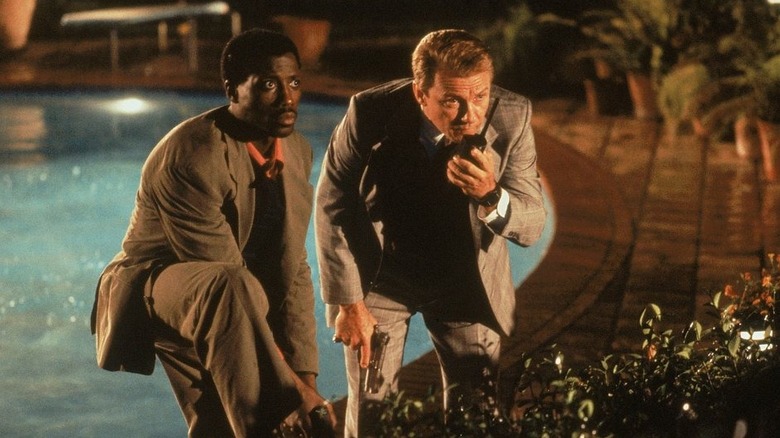
The plot for "Rising Sun" gets really complicated after that. The mood of the film is very flippant, almost comedic, as Smith and Connor traverse various neighborhoods of L.A. Just so Wesley Snipes has something to do, there is a scene where they visit a Black neighborhood, displaying that Connor can be out of his element, and that Web is. The film, however, feels a lot like an ego trip for Connery, as he is given all the wisdom and investigative acumen. He's essentially Sherlock Holmes with Snipes playing his Watson. That's not a bad setup, but it's boringly presented in an edgy neo-noir-like "Rising Sun."
Critics weren't too fond of Kaufman's movie. Roger Ebert gave the film two stars (out of four), writing that the Connor character was too smart for his own good. He also touched on the film's ostensible themes, which — like in Michael Crichton's novel — were meant to explore Japan's growing economic power and how it was overtaking the United States. But, Ebert wrote, the director never explored those themes. Ebert wrote:
"In the midst of servicing [its] cooked-up plot, the movie genuflects occasionally in the direction of its ostensible subject, American-Japanese competition. It's clear, however, that director Philip Kaufman didn't consider it one of his missions to make any sort of significant statement on this theme. Most of the Japanese in the film have motives that are easily understandable and often blameless."
More than anything, "Rising Sun" is an interesting time capsule about American economic fears in the early 1990s, and the attitudes that Hollywood had toward Japan's growing presence on the globe. As a thriller, though, it's pretty limp. We ranked it low, as far as Crichton adaptations go.


 English (US) ·
  Indonesian (ID) ·