
 2 months ago
Prime Video
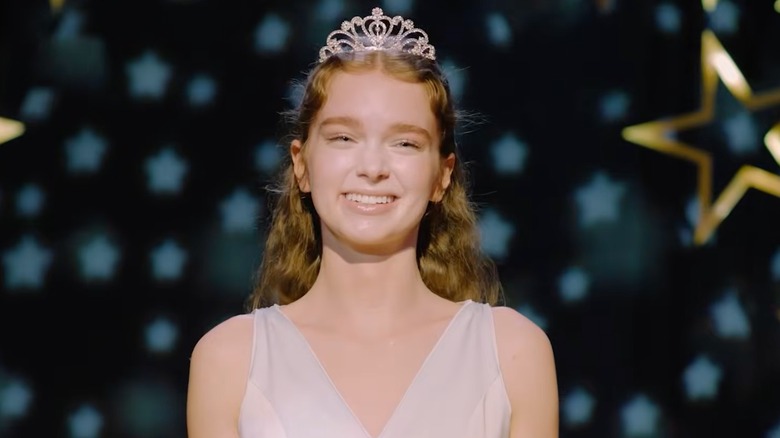
The first trailer for the "Carrie" miniseries, adapted by the horror filmmaker and Stephen King connoisseur Mike Flanagan, debuted tonight at San Diego Comic-Con 2026. The one minute long trailer shows events fans of the story will recognize: There's a close-up of Carrie White (Summer H. Howell) having been crowned prom queen, and while we don't see the moment where pigs' blood drops on her, there's snippets of the aftermath. (Including a foot-level shot of Carrie in a blood-soaked dress, or an auditorium on fire and filled with Carrie's dead classmates.)
There are also flashes of how Flanagan might be updating or stretching out the story. It appears mean girl Chris Hargensen (Alison Thornton), who masterminds the bloody prom prank, once tried (honestly or not) to be friends with Carrie. It's also shown that, presumably after inciting embarrassment when Carrie gets her first period in the school showers, some bullies make a "carrie red" Instagram account; that at least accounts for how teenagers bully each other in the 2020s.
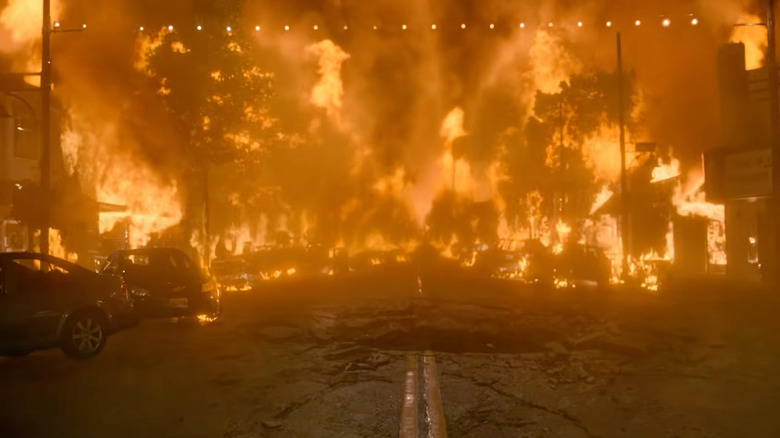
But other shots in the trailer indicate Flanagan will be lifting one thing from King's original "Carrie" novel that none of the previous films have. These shots show Carrie's hometown of Chamberlain, Maine on fire. In the novel, Carrie doesn't just use her telekinesis to get revenge on the people laughing at her in the auditorium. On her way home, she rampages across the entire town, triggering a gas line explosion that sends Chamberlain main street up in flames. Carrie's final body count in the book is around 440, compared to a "mere" 73 in the most famous movie adaptation, Brian De Palma's classic 1976 "Carrie." (Not that King minds the differences; he's got nothing but praise for De Palma's "Carrie.")
Carrie's rampage is much worse in the original novel
Prime Video
Stephen King's "Carrie" is an epistolary novel, meaning much of the story is told as in-universe reporting on Carrie's prom night rampage. The novel transitions back and forth between immediate third person, past tense segments of the characters living Carrie's last days in the moment, and then segments of newspaper articles, tell-all books, congressional testimony transcripts, academic journals etc. Towards the novel's end, Carrie's rampage is described both as it happens as well as by survivors who recount what they saw.
The novel's structure is to underline that people in-universe are trying to reach an understanding of what happened that night, and how those conclusions are often wrong. In-universe, Carrie is widely viewed as a monster, whereas the novel gives us a glimpse into the head of an ostracized, abused young girl.
The epilogue pages of "Carrie" underline that Carrie White basically destroyed Chamberlain, full-stop, and not just by burning key portions of it down. She killed so many people, including practically the entire high school graduating class, that the town just couldn't recover. Many families moved away, businesses closed, and by the end of the story, it's on its way to becoming a ghost town.
The cinematic version of the novel's structure would be a mockumentary or found footage film. The only "Carrie" adaptation that's tried something even resembling this is the maligned 2002 "Carrie" TV film written by Bryan Fuller. (It's been rumored the 2013 "Carrie" remake shot scenes featuring elements like this, but if that's true, they were cut and haven't surfaced.)
It's still unclear if Flanagan's will use this structure, either, but he at least looks to be finally adapting the full scale of Carrie's carnage.
"Carrie" premieres on October 7, 2026 on Prime Video.

 English (US) ·
  Indonesian (ID) ·