
 1 month ago
Paramount
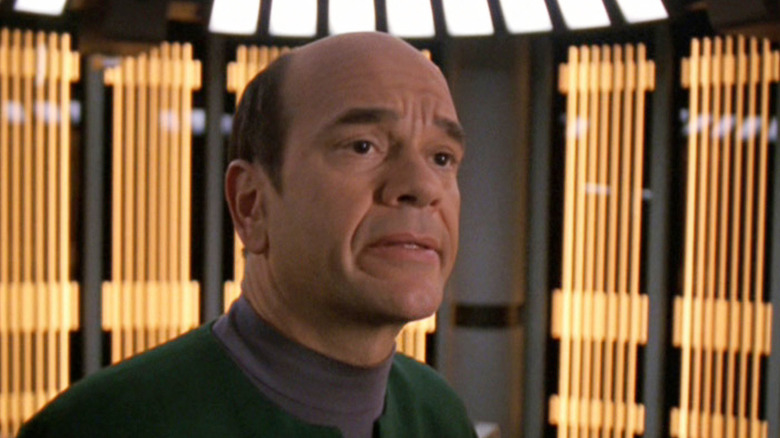
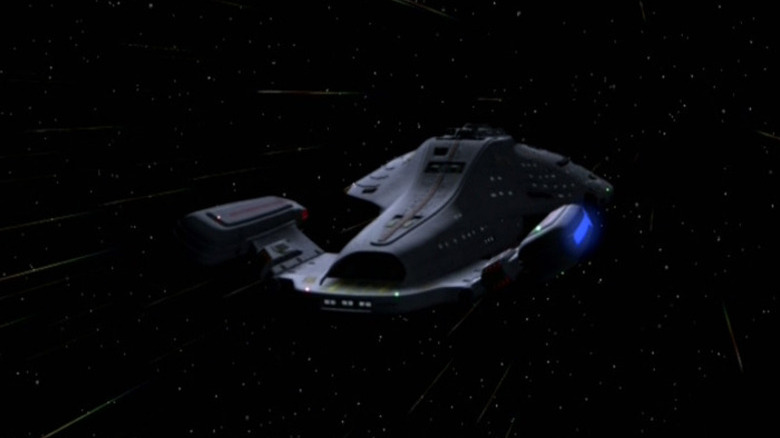
The premise of "Star Trek: Voyager" is daring and unique on paper. Thanks to the machinations of a godlike alien, the USS Voyager is whisked clear across the Milky Way in a matter of seconds and left stranded in the Delta Quadrant, a place where no one has ever heard of Starfleet, the Federation, or Earth. This means the Voyager and its crew are completely alone, having to defend themselves and replenish their ship's resources with no hope of receiving backup.
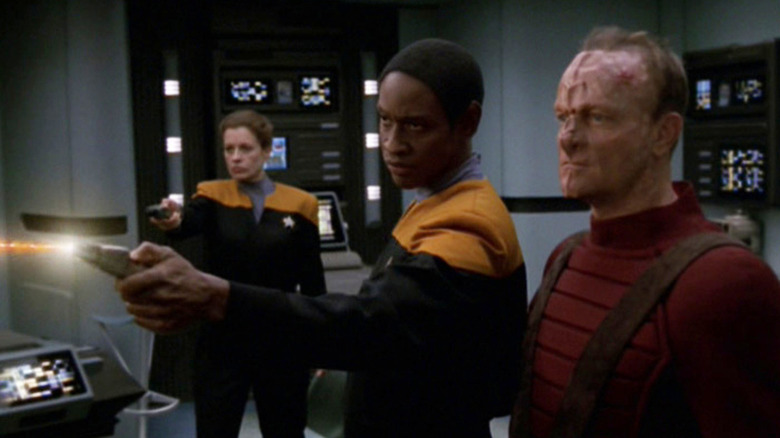
To make matters worse, much of the Voyager's crew is killed during its displacement, forcing the survivors to take on a ship of Federation-hating Maquis terrorists to fill out their numbers. This, in turn, creates a lot of interpersonal conflicts between Voyager's Captain Janeway (Kate Mulgrew) and the Maquis leader Chakotay (Robert Beltran). Between all this and the Voyager traveling through a mysterious part of space, the show promises to be much weirder and wilder than other "Star Trek" series in the early going.
Sadly, a lot of the show's promise is nixed as it goes along. For one, dwindling supplies is rarely an issue for the Voyager. Additionally, the Maquis conflict is more or less solved by the end of the pilot episode when Chakotay readily becomes Janeway's first officer.
As for "Voyager" taking place in "a weird part of space," it turns out it isn't so weird. Indeed, the Voyager frequently runs into the same kinds of aliens that could easily appear on "Star Trek: The Next Generation." Showrunner Brannon Braga, in particular, felt that "Voyager" should have been much more eerie and strange, as he explained in a 1996 issue of Sci-Fi Universe Magazine. Essentially, he thought "Voyager" should have been more like the "Star Trek" version of "The X-Files" but came up short.
Brannon Braga felt that Star Trek: Voyager should have been weird and eerie like The X-Files
Paramount
As Brannon Braga explained to Sci-Fi Universe Magazine:
"I think that 'Voyager' should be the 'X-Files' of 'Star Trek.' The Delta Quadrant should be the strangest place we've ver seen. [...] Instead, the aliens look a little too familiar, and we're not delivering enough high-concept science fiction. Don't get me wrong; we've had many excellent episodes, but I want to do more brain-twisting, challenging stories."
Recall that this was early in the show's run. "Star Trek: Voyager" debuted in January 1995 and had a truncated first season of only 16 episodes (as opposed to the then typical 26). So, when Braga gave that interview, the series was only about two-thirds of its way through its second season (one of the best seasons of "Voyager" overall).
Likewise, the Sci-Fi Universe Magazine interviewer pointed out that the show was still young and had time to improve. Braga, however, noted that while "Voyager" was a new series, the "Star Trek" franchise had already been around for 30 years by then. He added that he and the show's other writers "want to make sure we keep telling the best science fiction stories we can. That's the 'Star Trek' tradition, and that's what 'Star Trek' fans have come to expect." He added that a property with over 300 TV episodes under its belt should be subjected to more artistic scrutiny, and he wanted to use that to "keep it fresh."
He wasn't wrong. If "Voyager" had been the first "Star Trek" series ever, Braga would have had a lot more leeway to explore more traditional stories. But because it was the latest show in a decades-old franchise, he needed to step up his game and get weirder with it.
Even at the time, Star Trek: Voyager was criticized for its diversity
Paramount
One would've had to have been there to remember, but "Star Trek: Voyager" was criticized at the time for its diversity. The series features a woman as its captain, an Asian-American operations officer, and a Black Vulcan (among other things), but the criticisms weren't so much of the "angry racist a-hole" variety (though those were out there). Rather, they were about cynical media tokenism.
To that point, Brannon Braga acknowledged that he was well-aware of the complaints about tokenism. Nevertheless, he felt that diversity was the name of the game, especially in "Star Trek," which had been a multicultural franchise since the 1960s:
"I have mixed feelings about it. The whole idea of 'political correctness' has been taken to histrionic extremes; we're seeing a backlash to that right now. Some of it is positive. Maybe in the future, we won't have to walk around on eggshells all the time. And some of it is definitely negative — like affirmative action being eradicated. However, I don't think 'Star Trek' should be caught up in that backlash. 'Star Trek' has always made strides in diversity, and those strides predate terms like 'PC.' [...] I firmly stand behind our multi-ethnicity."
It should be noted that "politically correct" was the term right-wing types used to lambaste multiculturalism and building non-racist structures in the 1990s. It was used the same way "woke" is today. For the record, "Star Trek" has been "woke" since the beginning, declaring that strength lies in diversity. And there have always been review-bombers who whine about it.
"Voyager" may not have been as weird or as ambitious as Braga might have liked, but it was always a great "Star Trek" show, if only for its multiculturalism alone.




 English (US) ·
  Indonesian (ID) ·