
 2 hours ago
Paramount
Welcome to Trekspertise, a series where we break down the technology, history, details, and decisions that make the Star Trek universe so complex — and so fun.
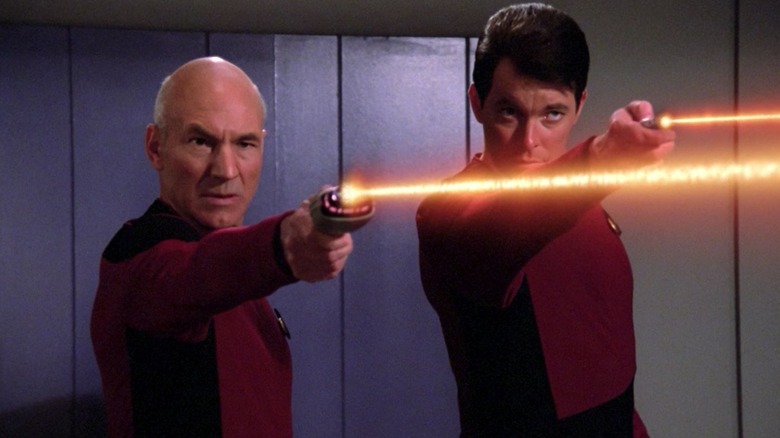
When Gene Roddenberry was first assembling "Star Trek" in the mid-1960s, the term "laser guns" was common enough sci-fi parlance that he astutely wanted to avoid using it. To make "Star Trek" seem a little more futuristic, Roddenberry invented "phasers" instead of "lasers," and the weapon became a staple of the franchise. Starfleet vessels are equipped with powerful phaser weapons used for ship-to-ship combat, and Starfleet officers carry hand-held phasers into potentially dangerous situations.
In the pilot episode for "Star Trek: Enterprise," a series set a century prior to the events of the original "Star Trek," Captain Archer (Scott Bakula) was shown a hand-held phaser — then called a phase pistol — for the first time, so Starfleet has been using them since the very start. Phasers tend to fire single, confined beams, but would also eventually come to fire brief, bullet-like pulses.
"Star Trek," however, is also meant to take place in a peaceful utopia, so the phasers were said to have a "stun" setting that could render an attacker unconscious from a distance. Only in extreme scenarios would a phaser be adjusted to the "kill" setting, which could blast the life out of someone. Indeed, throughout "Star Trek," the powerful kill setting was seen to vaporize a person's body entirely.
On "Enterprise," phasers only had "stun" and "kill" settings, but later on, there were other, gentler settings. Throughout the franchise, characters have been explicit about the various settings a hand phaser was capable of using, sometimes referring to "light stun," "heavy stun," or a numerical system.
What do those numbers and settings mean? Let's take a look.
There are more phaser settings than just stun and kill
Paramount
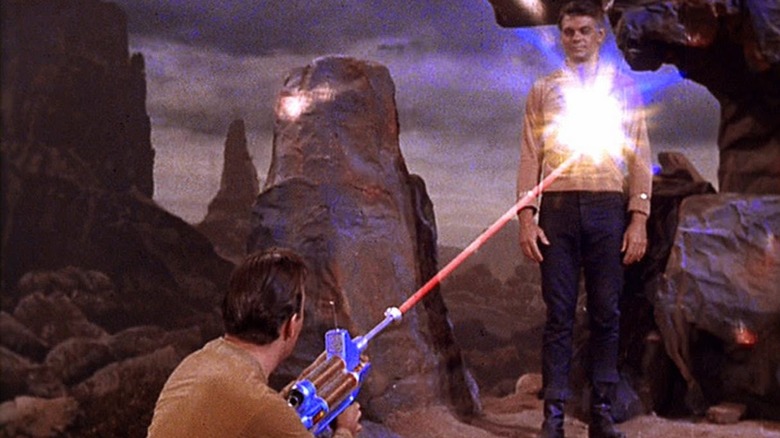
Eagle-eyed "Star Trek" viewers might notice that Starfleet officers typically use two different types of phasers. The Type-1 phasers are the smaller, thumb-activated, remote-control-looking widgets, while the larger, pistol-shaped phasers are Type-2. On "Next Generation," the Type-2 also became a thumb-operated device. Only very occasionally would one see a larger phaser rifle, like the one Captain Kirk (William Shatner) used in the episode "Where No Man Has Gone Before."
In the "Star Trek: Discovery" episode "Saints of Imperfection," Tilly (Mary Wiseman) also noted that the rifle is designated a Type-3 weapon by saying, "It is more powerful and generally larger than the Type-1 or Type-2, which I guess is why they call it a 3."
The original phaser sound effect, a high-pitched whine, was repurposed from the 1953 film "The War of the Worlds." The common "Star Trek" phaser sound has remained a variant of that whine ever since.
It was in the episode "The Enemy Within" that "setting one," a phaser's lowest setting, was first mentioned. This was enough to, well, stun the average humanoid. In the episode "The Return of the Archons," the Enterprise crew set their phasers to a wide-beam setting that could essentially spray across a crowd, stunning multiple people at once. (It's a good thing I don't have a phaser with a wide-beam setting; I would never wait in line for a ride at Disneyland ever again.)
On "Star Trek: Deep Space Nine," specifically in the episode "Homefront," there was some mention that setting 3.5 or 3.6 constituted a "heavy stun." It wouldn't be until a phaser was set to setting 10 that it would be capable of vaporizing someone. Starfleet seems more interested in gradations of stunning someone before it considers a kill setting ... but those puppies can do a lot of damage.
How powerful are those hand phasers?
Paramount
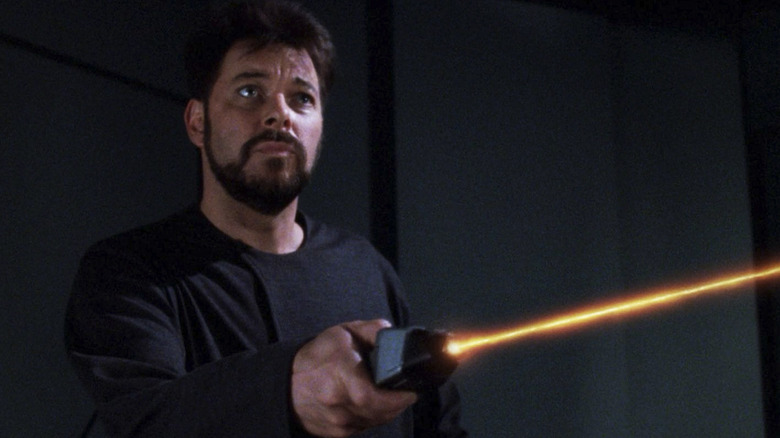
In the "Next Generation" episode "Frame of Mind," Riker (Jonathan Frakes) has a scene where he sets a Type-2 phaser to its maximum setting of 16. He states out loud that if a phaser were to fire at such a setting, it would destroy half the building. Phasers, if wielded irresponsibly, could apparently do a great deal of damage. Of course, these are hand-held devices and don't have an infinite power supply. I think it's safe to assume that a phaser, firing a level-16 blast, could only do it once. I'd hate to live in a world where someone could stroll through a city, blasting open multiple buildings willy-nilly with a single handgun-sized object.
A stun setting could knock someone out without leaving a mark, but, judging by various makeup jobs seen throughout "Star Trek," heavier settings left bruises or even burn marks on people. Before you think you could withstand a heavy stun, watch one of those foolish online videos where macho idiots — or perhaps just the cast members of the "Jackass" crew — test to see if they can withstand a taser or pepper spray. I imagine a phaser blast would be the sci-fi version of that.
Of course, throughout "Star Trek," officers also used phasers for things other than tactical confrontations. They could be used as cutting torches, or to heat up rocks in order to keep warm in frozen climates. In the "Next Generation" episode "Disaster," a phaser's power cell was used as a power source for a computer terminal. Phasers may have the ability to explode entire buildings, but they are more often used as tools in a Starfleet officer's toolbox.
Utopia retained.



 English (US) ·
 Indonesian (ID) ·