
 3 months ago
Christopher Polk/Getty Images
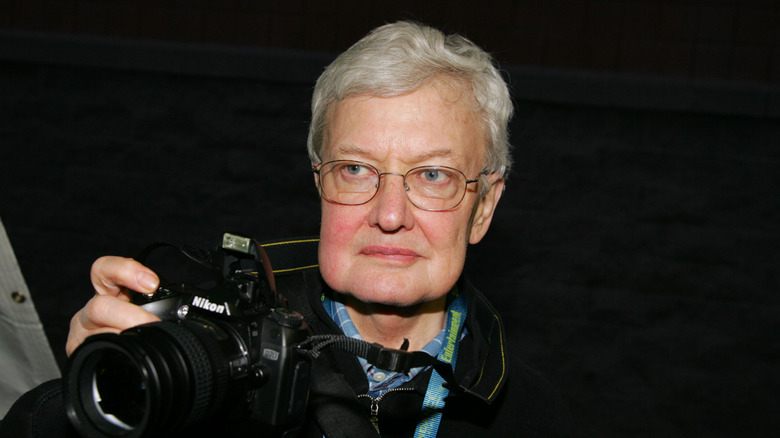
At this point in time, Roger Ebert's name is as synonymous with film criticism as Steven Spielberg's is with directing. The legendary film critic, who was born in Illinois in 1942 and passed away in 2013 after multiple battles with cancer at the age of 70, is known for his harsh but fair reviews, his quippy one liners, and thoughtful approach to his writing. For decades, Ebert famously watched and reviewed movies for the Chicago Sun-Times, where he championed directors like Werner Herzog, Martin Scorsese, and Spike Lee. Famously, he was also a television personality — initially alongside Gene Siskel on their eponymous show "Siskel & Ebert," but he continued the tradition alongside Richard Roeper after Siskel's tragic death related to a brain tumor in 1999. Ebert's influence is vast, and it's safe to say that generations of critics and culture writers still look to his body of work to improve their own craft. (I know I do.)
Ebert dealt with many health struggles throughout his life but, rather than retire from his profession or dwell on his own mortality, he decided to spend his life and time helping other people love movies as much as he did. So with that in mind, I want to really hone in on one of his most beloved quotes about movies ... or, rather, what movies are "about."
Quote of the Day by Roger Ebert
Static Media
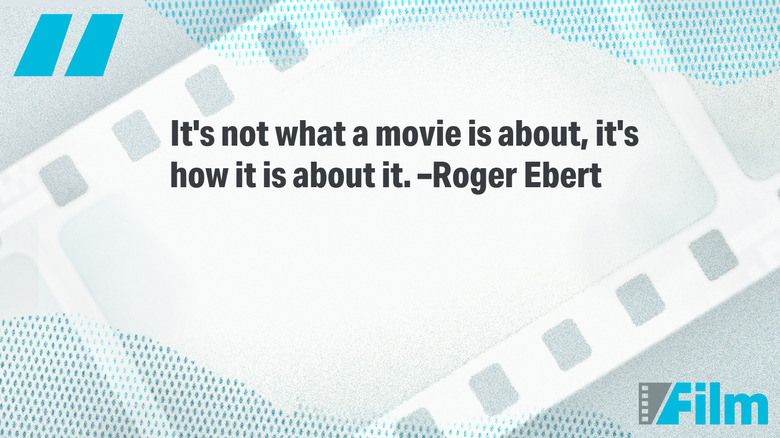
The quote is simple: "It's not what a movie is about, it's how it is about it." So what does that mean, exactly, and where does it come from?
To the second question, I'm not sure. At the risk of committing journalistic malpractice, this quote has been so widely circulated and attributed to Ebert across decades that tracking down its original origin is nearly impossible, though he has reiterated versions of it many times over the years (this isn't a Mandela effect sort of thing). It's so commonly associated with Ebert, in fact, that this quote is informally referred to as "Ebert's law."
I am, obviously, not Roger Ebert, nor am I possessed by the spirit of the late famous film critic. I am, however, someone who also loves movies and reveres Ebert for that reason. Now that I've cleared that up, I'll return to that initial question: what does it mean? It's both exceedingly simple and delightfully complex, but the gist is this: there are, to a certain extent, a limited number of existing plot and character archetypes, and every story does need to follow some rules in order for the narrative to truly work. How the movie's story goes about that, though, is the bigger question that Ebert is concerned with here.
The Deeper Meaning of This Famous Roger Ebert Quote
Ethan Miller/Getty Images
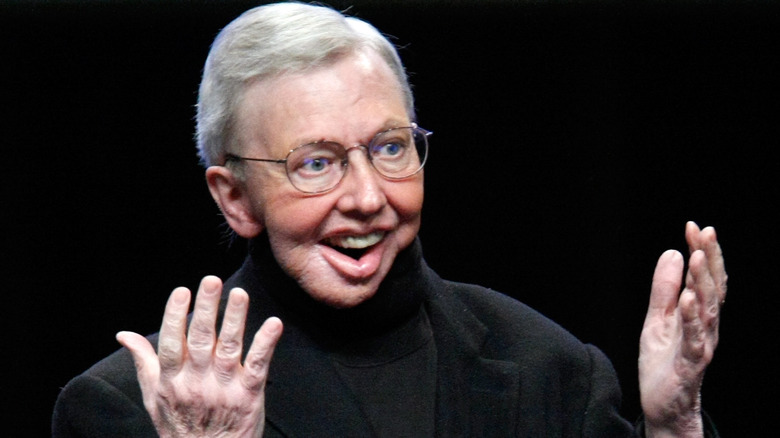
Let's look at a genre that I don't much like to illustrate the meaning of this Roger Ebert quote: music biopics. I am, admittedly, exhausted by this genre; the only two I've ever genuinely enjoyed are "Walk Hard: The Dewey Cox Story" and "Popstar: Never Stop Never Stopping," because they are both A) parodies and B) fictional. They all follow the same formula, which is the source of my distaste. The artist in question — almost always a man — experiences a sudden rise to fame thanks to their extreme talent, squanders opportunities by engaging in hedonistic behavior (which usually means they discard their "starter" wife for a younger, hotter model), sees a fall from grace, and then is given a chance to rise again. Also, in the Timothée Chalamet one about Bob Dylan, he's really pressed about what kind of guitar he wants to play.
I'm being flip, but Ebert's point stands: if a movie is "about" a rock star's rise, fall, and rise again, that's just one aspect. How does it explore that topic, though? Does it do something actually cool, like when Robbie Williams turned himself into a CGI monkey for "Better Man," or does it follow the same paint-by-numbers formula as the rest of the genre like "Bohemian Rhapsody" or "Walk the Line?" (I wonder if Ebert would have loved "Better Man.") Ebert knew and believed that every story has an interesting approach, hence the "how it is about it" part of this quote. On a more binary level, every story is about a hero and their struggle, and there are so many interesting ways to express that. Ebert understood this innately, and it's why his words remain immortal.
More Quotes From Roger Ebert
Kevin Winter/Getty Images
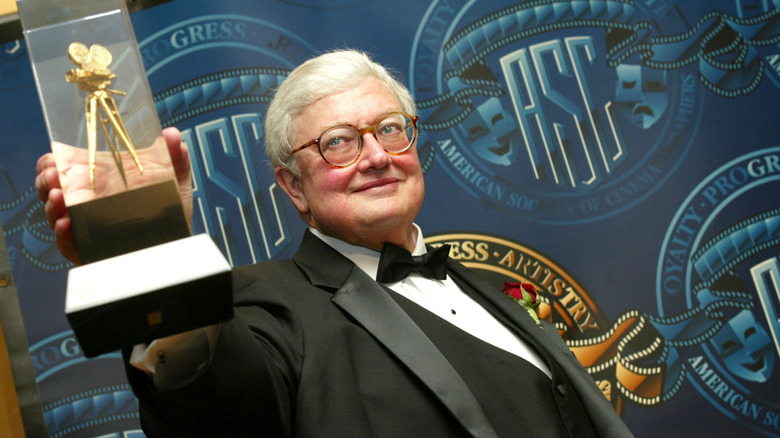
- "No good movie is too long and no bad movie is short enough."
- "We live in a box of space and time. Movies are windows in its walls."
- "A depressing number of people seem to process everything literally. They are to wit as a blind man is to a forest, able to find every tree, but each one coming as a surprise."
- "I believe that if, at the end of it all, according to our abilities, we have done something to make others a little happier, and something to make ourselves a little happier, that is about the best we can do. To make others less happy is a crime. To make ourselves unhappy is where all crime starts. We must try to contribute joy to the world. That is true no matter what our problems, our health, our circumstances. We must try."
- "Life always has an unhappy ending, but you can have a lot of fun along the way, and everything doesn't have to be dripping in deep significance."
- "Doing research on the Web is like using a library assembled piecemeal by pack rats and vandalized nightly. "
- "I was born inside the movie of my life. The visuals were before me, the audio surrounded me, the plot unfolded inevitably but not necessarily. I don't remember how I got into the movie, but it continues to entertain me."





 English (US) ·
  Indonesian (ID) ·