
 4 months ago
Paramount
We may receive a commission on purchases made from links.
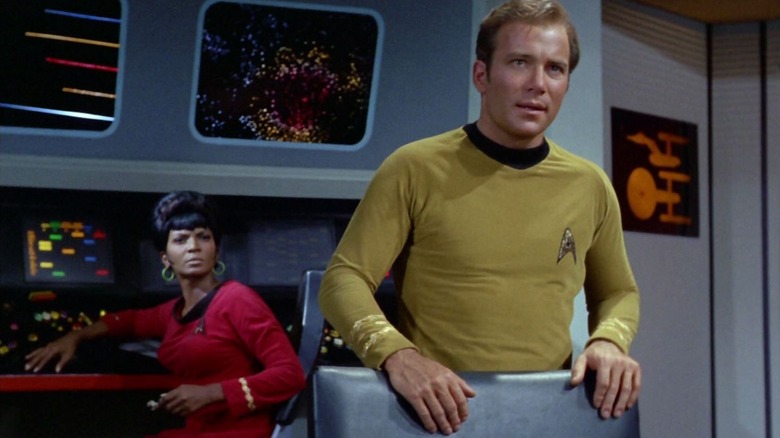
Most Trekkies will happily bend your ear about the glorious utopian diversity that "Star Trek" so obviously foregrounded in every one of its episodes. Show creator Gene Roddenberry had a bridge crew that represented a united humanity. Japanese-American actor George Takei played the Japanese helmsman Sulu. Nichelle Nichols, a Black woman, was often in frame on the Enterprise's bridge, serving as the ship's communications officer, Uhura. In the show's second season, Roddenberry added a Russian character, Pavel Chekov, played by Walter Koenig, to indicate that even Cold War tensions will have cooled off by the 23rd century. It was a whole ensemble.
In future iterations of "Star Trek," the multicultural ensamble would just be codified. Starting with "Star Trek: The Next Generation," Roddenberry would also infamously double down on his peaceful, utopian ideas, instructing writers that they weren't permitted to depict any kind of interpersonal conflict between the show's many main characters. The so-called Roddenberry Rule frustrated writers, of course, as they couldn't imagine too many other ways to manufacture drama than through interpersonal conflict.
Non-conflict and multiculturalism were good ideas, though, and they have defined "Star Trek" for 60 years. But Roddenberry had to fight for them.
Indeed, back in the 1960s, Roddenberry was constantly butting heads with CBS over the character of Uhura. It seems that Roddenberry wanted Uhura to play a larger role in the series, but the overlords at CBS kept on asking that her character be downplayed. This was all according to Nichelle Nichols in a 1996 issue of Cinefantastique Magazine. It seems that many "Star Trek" scripts had more prominent scenes for her character, and her role was constantly being reduced in rewrites. Nichols was, naturally, frustrated by this.
Uhura's role kepts getting reduced in Star Trek script rewrites
Paramount
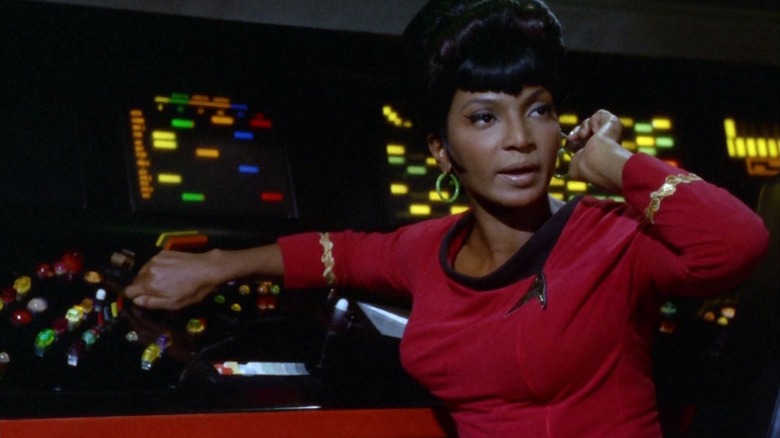
As mentioned, Uhura was typically in the center of the frame in most establishing shots of the Enterprise's bridge on "Star Trek." She might have been in the background in many scenes, but her constant presence on camera reminded viewers that she was playing a vital function on the ship. As Nichelle Nichols recalled in 1996, Uhura was always meant to be more than just physically centered. She was supposed to have many more lines and scenes throughout the series. But her lines were being cut all the time. As Nichols put it:
"That was part of the disappointment. There were wonderful roles written. Gene really meant to achieve that equality of the people, in scripts as well as deed and fact. What happened, as I pointed out in my book, is that it kept getting killed in the rewrites. It was so frustrating, that finally I would not read the white pages. I would wait until the final one, and then deal with it. It was wimply too frustrating."
The "white pages" are scriptwriting lingo for a script's first draft. Subsequent drafts are printed on other colored pages to differentiate them. Nichols' book, meanwhile, was her autobiography "Beyond Uhura: Star Trek and Other Memories," published in 1994.
It wasn't just happenstance, however, that saw Uhura's scenes being cut. Nichols knew that all the changes were coming from higher up the chain, somewhere within the CBS network offices. The network had final approval on the scripts, and Nichols was convinced that someone wanted her role reduced. Uhura was written to be an ever-present and strong character, and that, Nichols suspected, was too much for CBS.
Nichelle Nichols knew the studio didn't like Uhura's strength
Paramount
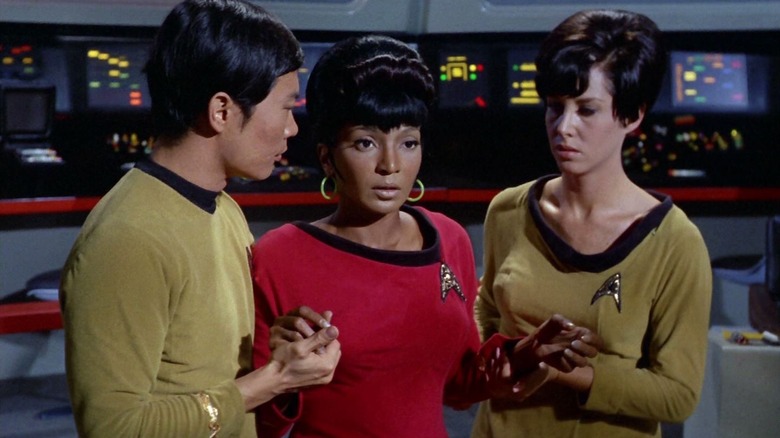
The way Nichelle Nichols put it, "Star Trek" already had two lead actors in William Shatner and Leonard Nimoy. They were, in the show's first season, the only two actors listed in the opening credits. The rest of the recurring ensemble cast's credits were shoved to the end. It wouldn't be until "Star Trek VI: The Undiscovered Country that they all received equal billing.
For Nichols, the issue was merely a matter of star power. In her words:
"The network had final say, and that's there the changes came. Gene had made me too strong a character, and they didn't want that muc involvement. You see, Gene gave to television the first ensemble of stars. The networks and the studios and, I would just say, the industry, I think simply were not ready for more than two stars on a show. They had no frame of reference for it, and felt it would not be accepted. But fandom went above their heads and accepted us anyway."
Although Nichols didn't address it directly, one can assume that racism and sexism might also have played a part in Uhura's reduced role, and it likely wasn't merely an issue of thinly spread star power. Black woman didn't have lead roles in too many shows prior to "Star Trek."
Nichols' mere presence on "Star Trek" was notable, however. The story is well known to Trekkies, but evidently a young Whoopi Goldberg saw Nichols on "Star Trek" and ran down the hall, yelling excitedly to her mom, "There's a Black woman on television, and she ain't no maid!" Martin Luther King himself told Nichols to stay on "Star Trek." That's advice you take.


 English (US) ·
  Indonesian (ID) ·