
 4 months ago
Bleecker Street/Fox Entertainment Studios
This post contains spoilers for "Slanted."
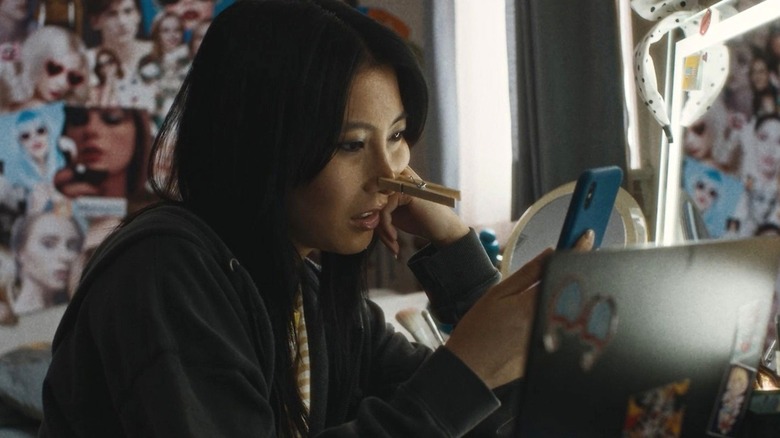
Body horror has always been about metamorphosis. These changes can be literal, like in Coralie Fargeat's "The Substance" or bring irreversible changes to the psyche, like in David Cronenberg's "Videodrome." While this subgenre is inherently subversive, the premise of Amy Wang's body horror-comedy, "Slanted," is bound to stir up controversy. And you can now watch it on Paramount+. In "Slanted," Chinese-American teen Joan (Shirley Chen) undergoes an experimental ethnic modification surgery to fit skewed beauty standards that reward whiteness. This is a slippery slope, given that a person of color voluntarily seeks out the homogeneity (and social acceptance) that comes with whiteness to evade racial discrimination and prejudice.
That said, Wang handles her ambitious feature debut with grace, weaving a scathing satire that attempts to comprehend the nuances of the Asian-American experience. "The Substance" tackled the horror inherent in ageism, and how repulsively commonplace it is in an industry that celebrates and fetishizes youth at the same time. Although "Slanted" also deals with the dangers of narrow societal beauty standards, race is placed at the forefront of Joan's coming-of-age experience. Such a subject naturally elicits discomfort, especially when we see how Joan's self-loathing has been actively shaped by frequent microaggressions and the invisible pressure to assimilate into a certain brand of American values.
After Joan undergoes the ethnic modification surgery, she calls herself Jo Hunt — a new identity played by Mckenna Grace. But what does this simulated identity mean in terms of Joan's sense of self, and how does it alter her worldview? "Slanted" makes a sincere attempt to dissect these themes, but only manages to scrape the surface. Even so, the film's blunt satire is scathing enough to raise pertinent questions about beauty standards and its twisted relationship with social currency.
Slanted is an imperfect, but compelling satire about problematic beauty standards

Bleecker Street/Fox Entertainment Studios
Wang's "Slanted" makes it clear that Joan's willingness to become Jo comes from putting whiteness on a pedestal. Popular influencer Olivia (Amelie Zilber) becomes an aspirational standard for Joan, so much so that she starts bleaching her hair and using an app to alter her natural features in selfies. After she becomes Jo, those closest to Joan, such as her best friend Brindha (Maitreyi Ramakrishnan) get humiliated and sidelined. Joan also experiences a steady disconnect with her parents, which extends to her own cultural customs and heritage. This is horrifying enough, but "Slanted" takes "The Substance" route once the surgery starts having unintended effects on Joan's appearance.
Wang's premise might be shaped by contemporary influences, but the roots of this satirical concept can be traced back to George S. Schuyler's "Black No More," which critiques the use of race as a commodity in 20th-century America. Schuyler's book centers on a surgical process similar to the one in "Slanted," which is used to deconstruct race-based economic inequity and how internalized racism heightens alienation among Black communities. While Schuyler's satire bares fangs and refuses to mince words, Wang approach to the subject matter feels meek and diplomatic. Although "Slanted" is confident in its body horror elements and bold setting, it doesn't always succeed in confronting the systemic prejudices it highlights.
2026 has shaped up to be a great year for horror so far, and you can count "Slanted" among the worthwhile entries. What the film lacks in thematic consistency is compensated for with committed performances from both Chen and Grace, and there's plenty to admire here.
"Slanted" is streaming on Paramount+.








 English (US) ·
  Indonesian (ID) ·