
 3 months ago
Paramount
A "Star Trek" layperson might reasonably wonder why most non-humans in the sci-fi franchise have two arms, two legs, one head, and are otherwise humanoid in appearance. However, there's a canonical explanation for that. In the "Star Trek: The Next Generation" episode "The Chase" (which was a tricky "Next Generation" episode to make for multiple reasons), it's explained that an impossibly ancient humanoid species, to avoid loneliness, seeded multiple worlds with their own DNA, causing most humanoid beings in the Milky Way to evolve looking kind of the same.
Of course, there are much more practical reasons why most aliens look like humans on "Star Trek." For one, a human-faced alien is going to be more relatable and recognizable to a human audience; it's harder to make, say, a living rock like Rocky in "Project Hail Mary" a sympathetic figure.
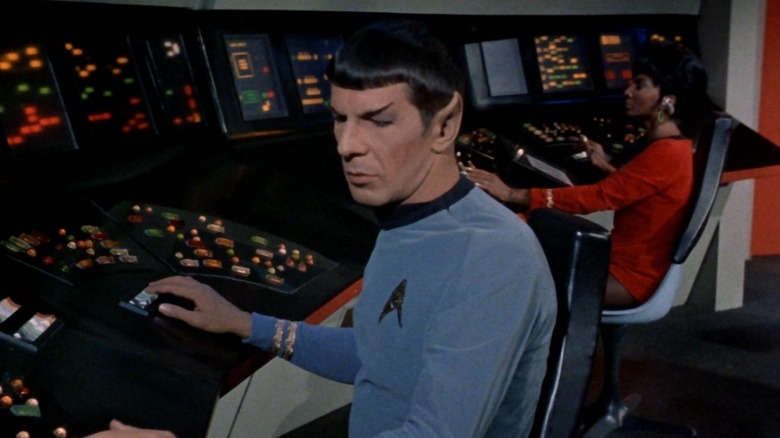
More so, though, it's a handy-dandy way to cover the very immediate and real-world fact that all aliens on "Star Trek: The Original Series" had to be played by human actors. Most aliens on the show are essentially humans with weird bumps on their foreheads or, in the case of Spock (Leonard Nimoy), pointed ears and angled eyebrows. This approach to creating aliens was practical and budget-conscious. If one wanted to populate the Enterprise with alien beings, it's cheaper to slap some pointed ears on an actor and call 'em a Vulcan.
This was something that "Star Trek" creator Gene Roddenberry apparently admitted out loud. According to Smithsonian Magazine's "Star Trek" oral history, Nimoy recalled having a conversation with Roddenberry where the latter explained that he needed an alien on the bridge of the Enterprise, specifically to help give the impression that aliens and humans live together peacefully, and that Spock's (humanoid) presence was the cheapest way to do that.
Leonard Nimoy's light Spock makeup was the cheapest way to show that aliens lived among humans
Paramount
Per Leonard Nimoy's recollection, he went to Desilu Studios (which oversaw "Star Trek" in 1966) to have a meeting with Gene Roddenberry about a sci-fi show he was working on, set on a starship in the future. Nimoy said that Roddenberry wanted him to play an alien character on the series. The actor, however, didn't seem concerned about the show's genre or his role; he just wanted a nice gig. "I figured all I had to do was keep my mouth shut," he explained, "and I might end up with a good job here."
Nimoy then discussed what Roddenberry told him about the narrative function of this alien character, saying:
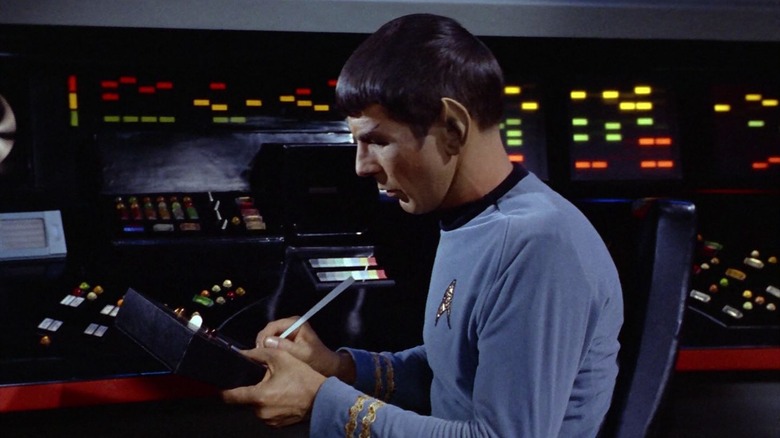
"Gene told me that he was determined to have at least one extraterrestrial prominent on his starship. He'd like to have more, but making human actors into other life-forms was too expensive for television in those days. Pointed ears, skin color, plus some changes in eyebrows and hair style, were all he felt he could afford, but he was certain that his Mr. Spock idea, properly handled and properly acted, could establish that we were in the 23rd century and that interplanetary travel was an established fact."
Had Roddenberry had the time and the budget, it's possible that more members of the Enterprise bridge crew would have been aliens like Spock. As it stands, Spock fulfilled his function well, communicating that humans and aliens did indeed work together all the time. And all it took was some eyebrow makeup, a pair of little rubber eartips, and some yellowish foundation. Well, that and Nimoy's excellent less-than-human performance as Spock, naturally.
Those eartips, incidentally, are currently on display at the Smithsonian Air & Space Museum.





 English (US) ·
  Indonesian (ID) ·