
 3 months ago
United Artists
We may receive a commission on purchases made from links.
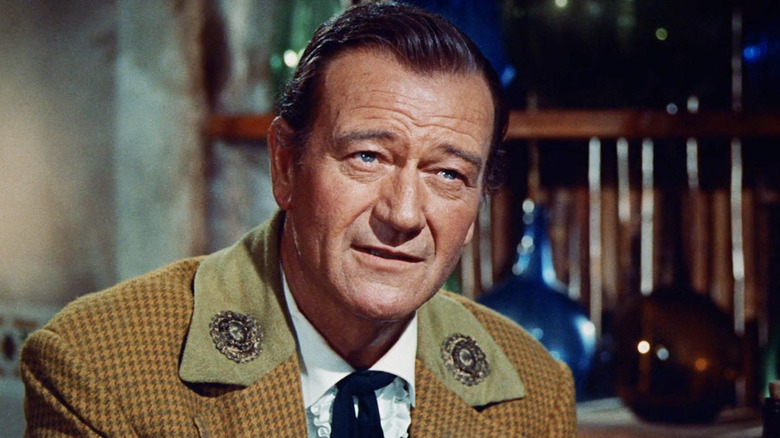
John Wayne only directed two movies in his career, and both had major problems. It's one of the things that separates him and his spiritual successor, Clint Eastwood. As iconic as the Duke was, he was never all that talented behind the camera. 1968's abysmal "The Green Berets" is the most convincing piece of evidence to support that claim, with Roger Ebert even deriding this Wayne stinker as "cruel and dishonest." While it's generally looked upon much more favorably, 1960s "The Alamo" wasn't actually that much better, even if Wayne himself stood by his passion project.
Not only was the film full of inexplicably lengthy speeches and leaden dialogue — much of which was spoken by Wayne's Davy Crockett — "The Alamo" was criticized for a severe lack of historical accuracy, to the extent that J. Frank Dobie and Lon Tinkle, the Texas historians who consulted on the project, demanded their names be removed from anything to do with the movie. That said, as Scott Eyman, author of "John Wayne: The Life and Legend" points out, the Duke hadn't necessarily intended to make something true to the historical record. Regardless, he faced significant criticism.
On top of all that, Wayne seemed to have infused a movie about a major moment in American history with his own anti-communist ideology as expressed in veiled terms via several of the aforementioned speeches. It made for a lukewarm reception from critics. What's more, while it wasn't as big a flop as 2004's "The Alamo," Wayne's warped retelling of the Battle of the Alamo failed to bring in enough money to recoup its egregious expenses. Given all that, why might the Duke stand by his 1960 directorial debut? Well, because it was a deeply personal project for him.
The Alamo fared well enough at the box office but it wasn't nearly enough
United Artists
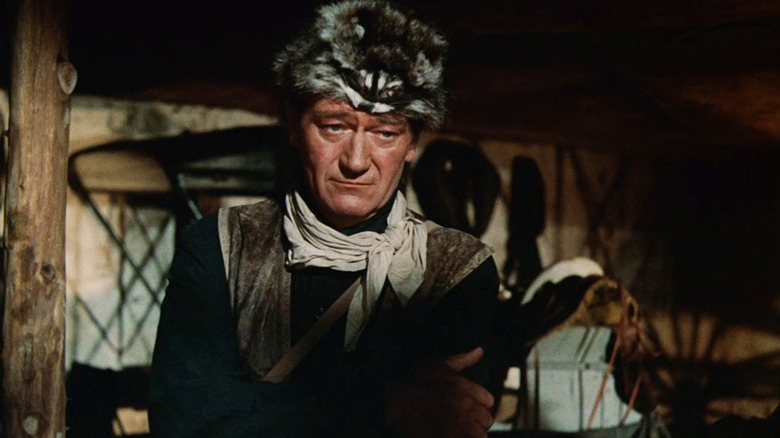
"The Alamo" made $7.9 million domestically. But behind the scenes, the film's budget had skyrocketed. A worksheet from John Wayne's Batjac Productions (via "John Wayne: The Life and Legend") reveals that the oft-listed final budget of $12.2 million is actually lower than what "The Alamo" cost Wayne's company. United Artists were paid a further $4.8 million for foreign distribution, bringing the final figure to an incredible $17 million. The film's total worldwide gross was $15 million. As far as Wayne was concerned, "The Alamo" was a commercial flop for him and his company. But it represented something far more important to the man himself.
In a 1971 interview, via Columbia University Libraries, the actor spoke about how the press made a meal of the financial fallout. "Well, you know, the industry, somehow or another, they get some story out of what a terrible flop it was," he said. "It made $15 million the first time around and I think I'm about the only director in the world that's made two — that every picture he has made has grossed better than $15 million. I had 'The Green Berets' and 'The Alamo.'" Pointing to one of the worst John Wayne movies probably wasn't the best defense.
But Wayne cared less about the surpassing a particular dollar amount than about completing his passion project. "I made a bad deal for myself on 'The Alamo,'" he continued. "United Artists made a great deal of money and I didn't. But I had it in my blood to do the picture. I wanted to do it. I was enthused with the period and the men and their relationships and they gave me the chance. So I'm not squawking."
John Wayne was always going to stand by The Alamo
United Artists
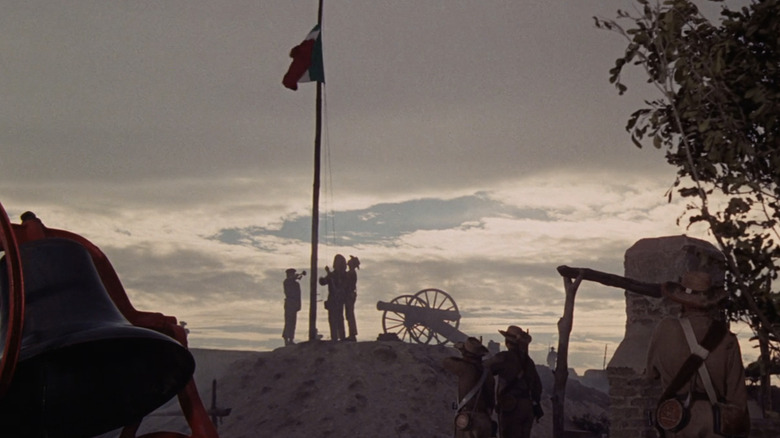
It makes sense that John Wayne defended "The Alamo." Aside from the fact it was his directorial debut, he had gone to war with the studio system in order to get "The Alamo" made. After deciding to make the movie back in 1945 (perhaps spurred by lingering guilt over having not served in World War II) he started preparing in 1947 when he flew to San Antonio to scout locations. Patrick Ford, son of the great John Ford who gave Wayne his big break with 1939's "Stagecoach," accompanied him, producing a first draft of the script. The picture wouldn't come together for another 13 years.
Arguments between Wayne and Republic Pictures over budget persisted for some time, as did a protracted feud between the Duke and Republic President Herbert Yates, which ended in a heated argument that ultimately saw Wayne leave Republic for good. It was almost certainly the right move given his issues with Yates. But it meant "The Alamo" would have to wait.
Wayne didn't give up. He soon formed Batjac Productions and managed to secure $2.5 million in funding from United Artists for his version of "The Alamo," (the distributor almost doubled their investment when Batjac paid that costly foreign distribution fee). In return Wayne had to abandon hopes of only directing and producing and agree to star. He also had to find the rest of the money, with Batjac eventually putting up $1.5 million while Wayne courted wealthy Texans for the rest. In the end, he had to use his own money to get the project over the line, even remortgaging his home. With all of that invested in the project, Wayne probably couldn't bear the thought of admitting defeat.


 English (US) ·
  Indonesian (ID) ·