
 2 months ago
At this point, most audiences are familiar with the time loop movie, in which a character or characters find themselves reliving the same 24 hours (or so) over and over again. We've seen this concept played out in a variety of genres, from the romantic comedy ("Groundhog Day," "Palm Springs") to action thriller ("Source Code") to slasher horror ("Happy Death Day"). No matter the genre, the time loop movie always has a strong subtext of existentialism, as it forces the characters stuck inside it to reckon with their existence and their place in the universe, as well as issues of free will, determinism, and so on. With that in mind, what if someone made a time loop movie that flipped the concept on its head while retaining so many of its themes?
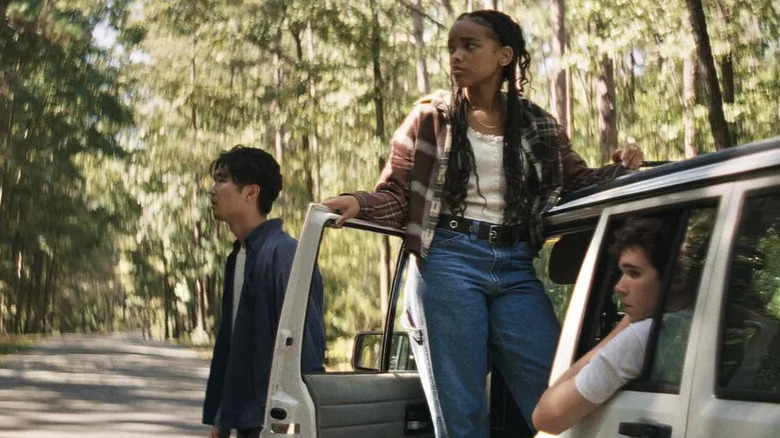
Those questions are addressed and then some in "It Ends," the debut feature from writer and director Alexander Ullom. The film concerns four recently graduated college friends (played by Phinehas Yoon, Akira Jackson, Noah Toth, and Mitchell Cole) who are enjoying a reunion hang when they happen to turn down a certain lone road. They soon discover that this road and the surrounding forest doesn't appear to have an end to it, and there's no way back. What's more, if they stop and leave their car for a certain length of time, dozens of people come out from the woods and voraciously attack them and their vehicle. As that description indicates, "It Ends" begins as a hellish nightmare. However, as the film's trailer (seen above) hints, the movie is much more than a traumatic chase film, or even a puzzle movie. Instead, "It Ends" is its own unique brand of existential thriller, and adds a new wrinkle to the rapidly growing liminal horror trend that movies like "Backrooms" have popularized.
It Ends brings out the existentialism within liminal horror
NEON
The liminal horror subgenre is still currently emerging and being defined, especially in cinema. Where prior cinematic trends have had a watershed film to rally around and emulate — think of 1978's "Halloween" kicking off the slasher boom — liminal horror isn't a strictly cinematic movement, as its tropes and aesthetic come as much from internet media as movies. Its eerie lack of definition can apply to characters, such as the living animatronics of "Five Nights at Freddy's," or to spaces, such as the house of "Skinamarink," the subway of "Exit 8," or the titular "Backrooms." Due to the fact that liminal horror is more about tone and aesthetic than formula or structure, the subgenre may never receive a rigid definition.
While on the one hand this makes new works which seem to be part of liminal horror harder to label, it also allows for richer and broader creative possibilities. Alexander Ullom has certainly taken full advantage of that with "It Ends," which I've already had the pleasure of seeing. Despite some truly nail-biting moments, the film isn't a traditional horror movie; even "Backrooms" ended up utilizing a stalk-and-chase slasher structure in its third act. Instead, "It Ends" heavily recalls theatrical existentialism, as its protagonists discuss and struggle with their predicament in a similar manner as the stage plays "No Exit" (by Jean-Paul Sartre) and "Waiting For Godot" (by Samuel Beckett). Yet where those plays concern older characters and their tortured lives behind them, "It Ends" is all about the horror of being thrust into a nightmare, one which is not of its Gen Z protagonists' making. In the same way "Backrooms" has inspired endless theorizing and discourse about its ultimately inexplicable world, I believe "It Ends" will continue the conversation.
"It Ends" will be released by NEON on August 21st, 2026.




 English (US) ·
  Indonesian (ID) ·