
 1 hour ago
Paramount
We may receive a commission on purchases made from links.
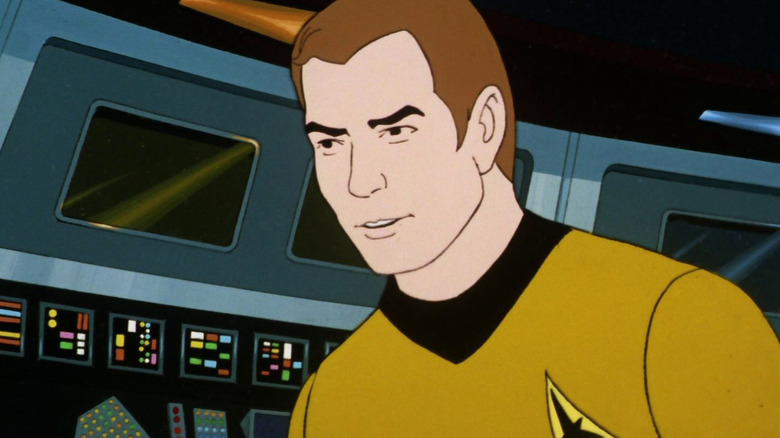
Even to this day, there's a debate over whether or not "Star Trek: The Animated Series" counts as a canonical installment in the "Star Trek" franchise. The show ran for 22 episodes over the course of two seasons from 1973 to 1974, and, in certain respects, it's actually better than "The Original Series." Being an animated 30-minute show, it's a lot more efficient in its storytelling and is able to visually realize far more expansive and outlandish ideas. For instance, it features aliens that evolved from plants and an episode that takes place largely underwater.
That said, there are aspects of "The Animated Series" that directly contradict other entries in the franchise. Take "The Counter-Clock Incident," an episode that introduces Commodore Robert April (James Doohan) as an elderly white man. However, when the character reappeared on "Star Trek: Strange New Worlds," he was played by Adrian Holmes, a Black actor. Then there's the episode "The Magicks of Megas-Tu," which is about the USS Enterprise traveling to the center of the galaxy and encountering a being believed to be the Devil. The thing is, this clashes with the film "Star Trek V: The Final Frontier," in which the Enterprise's crew meets an entity thought to be God at the center of the galaxy.
According to the oral history book "The Fifty-Year Mission," edited by Mark Altman and Edward Gross, "Star Trek" creator Gene Roddenberry himself even said that "The Animated Series" isn't strictly canon. Yet, a lot of the show has become canon over time, as some of the people who worked on it discussed in the short documentary "Drawn to the Final Frontier" (itself included on the series' DVD release).
The makers of Star Trek: The Animated Series felt it should be canon
Paramount
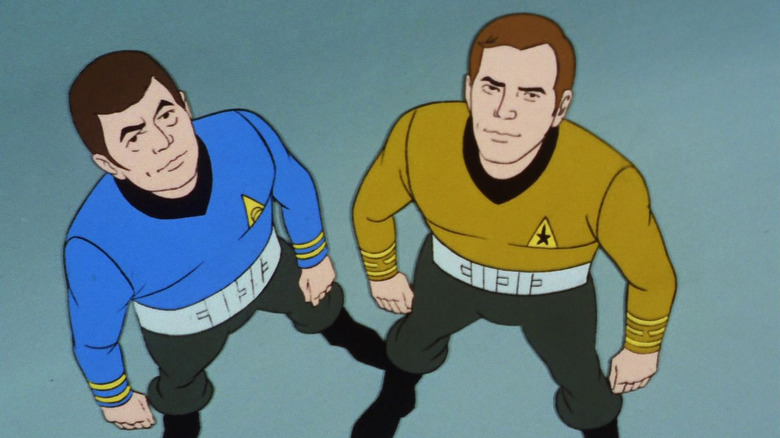
It should immediately be pointed out that "Star Trek: The Animated Series" was penned by many of the same writers who worked on "Star Trek: The Original Series," was created by Gene Roddenberry, and features most of the actors from "The Original Series" to boot (save for Walter Koenig as Chekov). What's more, in "Drawn to the Final Frontier," longtime "Trek" writer D.C. Fontana noted that "The Animated Series" had a research company to ensure it aligned with the events of "The Original Series." As she put it, "It has to follow. It has to make sense. They have to agree."
Expanding on this, "The Magicks of Megas-Tu" writer Larry Brody addressed the canon question directly in "Drawn to the Final Frontier," stating, "My take as to whether this fits into the 'Star Trek' legacy is that it fits into my version of the 'Star Trek' legacy. I think it should!" Meanwhile, "The Original Series" and "The Animated Series" writer David Gerrold said he felt that debates about canon are silly:
"All this argument about canon is stupid. It has Gene Roddenberry's name on it. It has William Shatner as Kirk, it has Leonard Nimoy as Spock, it has [DeForest] Kelley as McCoy, it has Jimmy Doohan as Scotty, it has Majel Barrett as Nurse Chapel, it has Nichelle Nichols as Uhura, it has George Takei as Sulu."
Likewise, when "The Animated Series" initially aired, it didn't really undermine what had been laid down by "The Original Series." Rather, it was the "Star Trek" shows and movies that came after it that led to problems. That sounds like canon to me.
Some of Star Trek: The Animated Series has become strictly canon
Paramount
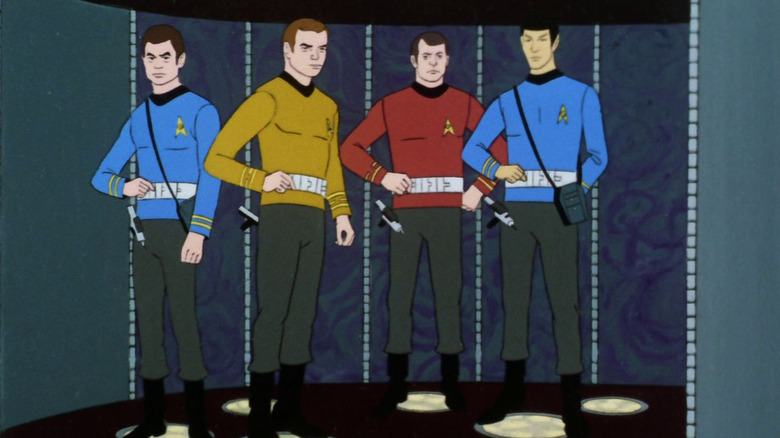
Indeed, many details from "Star Trek: The Animated Series" have since found their way into the live-action canon, like how James Kirk's middle name is Tiberius (as he clarifies in the "Animated Series" episode "Bem"). And though presented as a novel invention on "Star Trek: The Next Generation," the holodeck first appeared in the "Animated Series" episode "The Practical Joker."
In keeping with this, the show "Star Trek: Enterprise" incorporates several elements of "The Animated Series" into the mix. Specifically, a Sehlat — a Vulcan creature that serves as Spock's childhood pet in the "Animated Series" episode "Yesteryear" — appears in the "Enterprise" episode "The Forge." The "Enterprise" episode "The Catwalk" similarly confirms that Vulcans go on a desert-bound maturation ritual when they are children known as the kahs-wan, a term that was first spoken in, you guessed it, "Yesteryear."
And that's to mention nothing of the animated show "Star Trek: Lower Decks," which integrates myriad details and Easter eggs alluding to "The Animated Series." The latter show may be somewhat forgotten these days, but it's certainly worth revisiting (or watching for the very first time) and remains central to so much of the rest of the "Star Trek" mythology.
Is it canon? At least 80% so.





 English (US) ·
 Indonesian (ID) ·