
 12 hours ago
DreamWorks
Simon Wells' 2002 sci-fi flick "The Time Machine" was extrapolated from H.G. Wells' celebrated 1895 novel, one of the best sci-fi novels ever written, and also from George Pal's famed 1960 adaptation of the same story, itself one of the best time travel movies of all time. Made for a budget of $80 million, "The Time Machine" didn't overwhelm at the box office, earning almost $124 million worldwide. Critics were very unkind to "The Time Machine," and the film only has a 28% approval rating on Rotten Tomatoes, based on 151 reviews.
The movie isn't great, reducing the intellectualism of Wells' original novel into a rote sci-fi action thriller, but there was a steampunk quirkiness to "The Time Machine" that could have been more openly embraced. It was even nominated for an Oscar for Best Makeup.
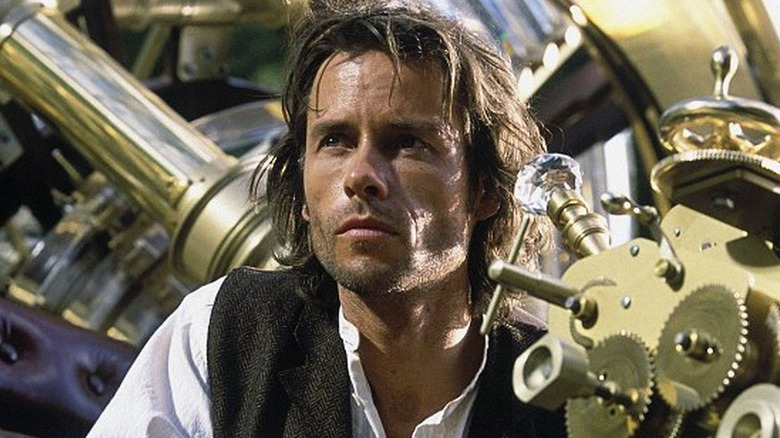
Guy Pearce plays Alexander Hartdegen, the inventor of the titular device, and he learns very quickly that mucking around with time travel doesn't always provide the result he's after. Alexander's motivation for building a time machine in the first place is to go back in time to prevent the murder of his fiancée (Sienna Guillory). This isn't part of the original novel, nor of George Pal's movie. Alexander spends five years building the time machine, and manages to save his fiancée, only to lose her again shortly thereafter. Something about the universe requires she die.
This kicks off a long-ranging time-travel adventure wherein Alexander begins tripping through the centuries, hoping to find an answer about how fate operates. He eventually ends up in the very, very distant future — specifically, the year AD 802,701 — when humanity has evolved into two distinct subspecies, the Morlocks and the Eloi.
The Time Machine added two characters who weren't in the original story
DreamWorks
The two most notable additions to the movie of "The Time Machine" that most dramatically depart from the previous versions are characters played by Orlando Jones and Jeremy Irons. Jones' character is, I would argue, a good addition, adding someone for the protagonist to converse with. Irons' character is ... well, his inclusion is just baffling.
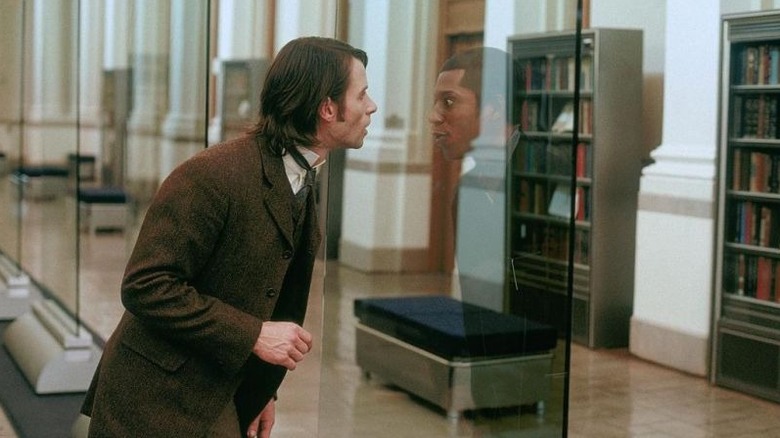
Jones plays Vox 114, an artificially intelligent digital library aide from the year 2030 who appears on glass screens. Because he is a computer, Vox is eager to teach people about science and the world. When Alexander, having just jaunted forward in time, asks Vox about time travel, Vox gets a little impatient, thinking Alexander just wants to talk about science fiction. Later in the film, Alexander finds Vox in a cave, somehow still operational hundreds of centuries later. Vox seems to have developed something of a consciousness over the years. He also still has a complete memory, remembering Alexander from this sojourn to 2030.
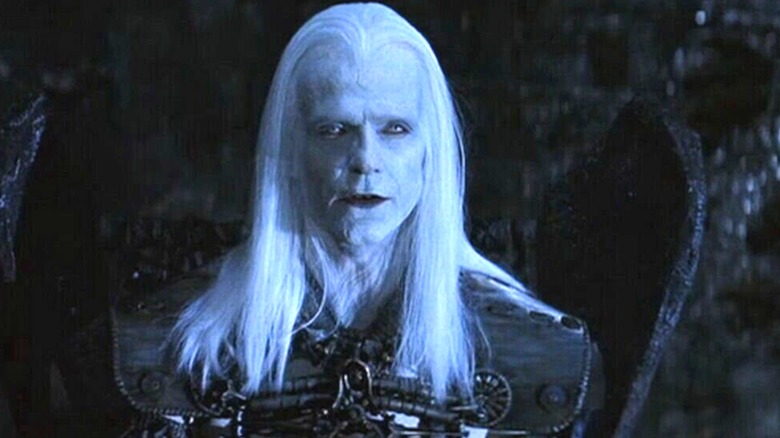
Irons, meanwhile, plays a character credited as the Über-Morlock, the psychic Cenobite-like leader of the Morlocks. As anyone who has read H.G. Wells' book can tell you, the Morlocks were an underground race of ape-like beings who feed on the Eloi who live on the Earth's surface. The Eloi, meanwhile, are placid, gentle, and defenseless. The idea is that the Morlocks evolved from old Earth's laboring classes, and the Eloi evolved from its aristocracy. Wells was clearly making a comment on class divisions, and how they will eventually play out if left to evolve along their logical extremes.
There is no Über-Morlock leading the underground monsters in the original book, and the inclusion of such a character in the 2002 movie is confusing and strange.
The Time Machine was not well-liked by critics
DreamWorks
That said, there is at least something delicious about Jeremy Irons' performance. He sports a long white wig, pasty white skin, and wears a bizarre, black pleather outfit that looks like it could be worn to a bondage bar. "The Time Machine" climaxes with the Über-Morlock and Alexander grappling while the machine hurtles forward in time millions of years. It's such a kooky conceit that you might find yourself enjoying "The Time Machine."
Some fun trivia: Simon Wells, the director of "The Time Machine" just happens to be the great-grandson of H.G. Wells. Simon Wells also co-directed the 1991 animated film "An American Tail: Fievel Goes West" (which was Jimmy Stewart's final film), as well as "We're Back! A Dinosaur's Story," the giant '90s animated hit "The Prince of Egypt," and several others. (He also helmed the massive Disney flop "Mars Needs Moms," but we'll forgive him this time.) All of this is to say that Wells was no neophyte in 2002, and he is not a traditional nepo baby who received an opportunity primarily because of his lineage.
Critics largely hated "The Time Machine." Roger Ebert gave the film one-and-a-half stars out of four, saying that it was "a witless recycling of the H.G. Wells story from 1895, with the absurdity intact but the wonderment missing." He noted that 800,000 years into the future, it was awfully convenient that Morlock and Eloi both seem to speak English. Guy Pearce's performance also didn't match the material. Ebert wrote that "Pearce, as the hero, makes the mistake of trying to give a good and realistic performance. Irons at least knows what kind of movie he's in, and hams it up accordingly."
Okay, so "The Time Machine" is not great. But Irons is fun. It certainly didn't deserve to bomb.






 English (US) ·
 Indonesian (ID) ·