
 2 months ago
Zoetrope Studios
Christopher Nolan has finally achieved an honor that outstrips his long string of gigantically successful blockbusters and multiple Oscars wins. Yes, Nolan was invited into the Criterion Closet to pick out whatever Blu-rays he might want to take, for free, out of the collection. At least, I assume it's free. Maybe the filmmakers invited into the Closet have to pay for the Blu-rays they select; something must be stopping them from bringing in a large canvas bag and full-arming a whole shelf of Blu-rays into it. Perhaps they just display more self-control than I would. I would Toys "Я" Us Sweepstakes that s***.
Criterion released its video of Nolan in the Closet, and he did indeed bring a canvas bag. He selected Don Siegel's 1964 crime flick "The Killers," which is based on a story by Ernest Hemingway and co-stars John Cassavetes, which seems in character for Nolan. Speaking of Cassavetes, the filmmaker then wisely selected Criterion's John Cassavetes box set (which includes "Shadows," "Faces," "A Woman Under the Influence," "The Killing of a Chinese Bookie," and "Opening Night") and very much liked "For All Mankind," Al Reinert's 1989 documentary film about the Apollo moon missions, underscored with music by Brian Eno. He didn't take the Blu-ray, though, because he already owned it.
Nolan was actually quite grabby. He also selected Orson Welles' "Mr. Arkadin" and Satyajit Ray's "Apu Trilogy" box set (a major influence on Martin Scorsese), admitting that he had seen "Pather Panchali" but not its sequels ("Aparajito" or "Apur Sansar"), along with Spike Lee's "Malcolm X" and David Lynch's rumination on the failure of masculinity with "Lost Highway." He even bagged Criterion's box set of Godfrey Reggio's "Qatsi" trilogy, describing the first film, 1982's "Koyaanisqatsi," as "one of the "great pieces of pure cinema."
Christopher Nolan ♡ Koyaanisqatsi
Zoetrope Studios
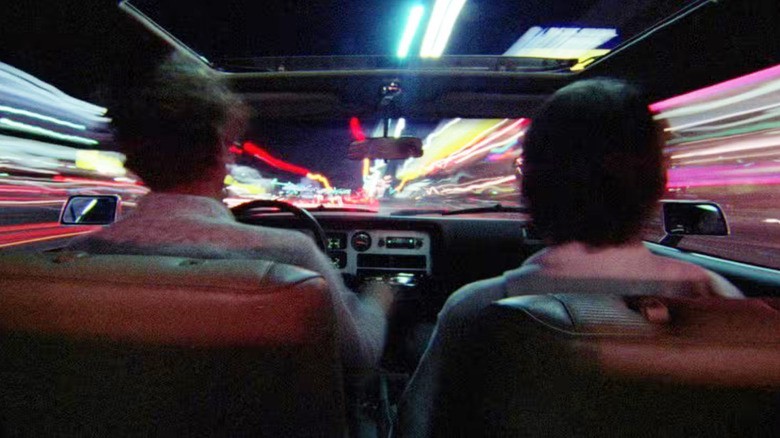
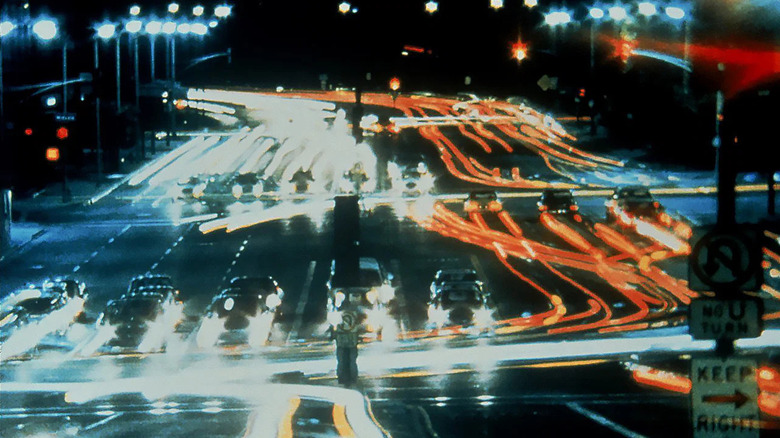
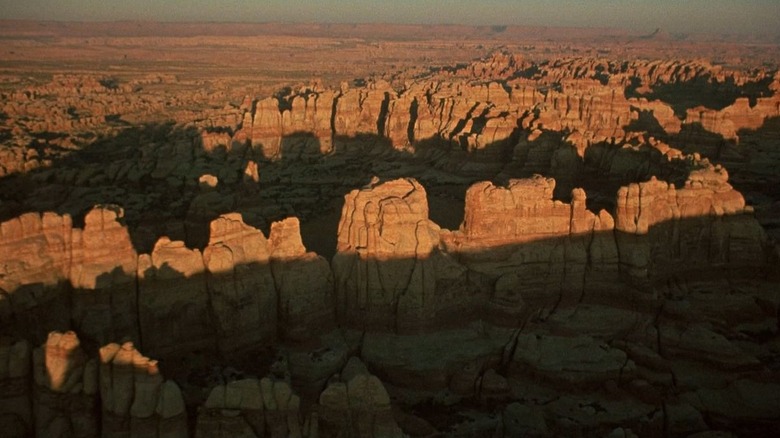
To answer the question right away: The title of "Koyaanisqatsi" comes from the Hopi language and translates to "life out of balance." The movie itself is an 86-minute montage of images, all gorgeously photographed, that depict wide, quiet nature scenes juxtaposed with quick-moving sequences of frantic, car-encrusted big cities. The film has no characters, narration, or even introductory chyrons. The closest we get is a basso profundo chanting of the title over some of the early scenes. Again, the movie is 86 minutes of this.
At first, the scenes in "Koyaanisqatasi" seem to be merely aesthetic, but the theme of the movie begins to emerge quickly. One will see slow-motion shots of the ocean cut very quickly to shots of strip-mining, for instance. We're witnessing an environmental treatise, a tragedy about the way humankind has sacked planet Earth for its beauty and replaced it with destruction. This becomes clear when filmmaker Godfrey Reggio shows footage of a nuclear bomb blast. The movie ends with a shot of a rocket firing into the sky and exploding, its pieces falling back down to the ground. It's heady stuff.
"Koyaanisqatsi" is part of a documentary genre that is sometimes called "pure cinema." Christopher Nolan wasn't just making a judgment call. Pure cinema is an avant-garde film genre that came into being among the French surrealists of the early 20th century and envisions a "pure" form of the medium that's free of literary or theatrical pretenses like story or character. One of the most famous works of pure cinema is Dziga Vertov's 1929 film school staple "Man with a Movie Camera." Reggio's "Koyaanisqatsi" might be the best known modern example and is generally regarded as one of the best documentaries ever made.
And it was the first part of a trilogy.
Koyaanisqatsi is part of a trilogy of pure cinema documentaries
Zoetrope Studios
In 1988, Godfrey Reggio returned to the pure cinema milieu with "Powaqqatsi." The title is still derived from the Hopi language, but this time, Reggio pieced it together himself to form a phrase that translates to "life in transition." "Powaqqatsi" is more focused than "Koyaanisqatsi," being more about increased industrialization around the world. The film begins with placid scenes of remote villages in Brazil and throughout the African continent, enjoying the beauty of the natural world. It then cuts to a montage of TV commercials and scenes of traffic. "Powaqqatsi," like "Kiyaanisqatsi," and its follow-up film, "Naqoyqatsi," features a score by Philip Glass. It's not, however, nearly as highly celebrated.
"Naqoyqatsi" wasn't released until 2002, and its title, the bleakest yet, translates to "life as war." In a way, it's the most poignant and ambitious of the three films, with Reggio making a point about the digitalization of humanity, a new state of consciousness wherein conflict drives our minds, and the world having reached a swirling climax of fast-moving violence. In Reggio's vision, he saw language and nature being replaced by digital code, all while the meaning of life was replaced by quantifiable victories, competition, currency, and war. "Naqoyqtasi" was released shortly after 9/11, making it notably timely, and fans of the film series will notice that it features far fewer scenes of natural landscapes and the beauty of the world. "Naqoyqatsi" is about the dissipation of the natural world altogether.
Reggio, now about 86, continued to make movies thereafter. In 2013, he directed the hypnotic experimental documentary "Visitors," which is a long montage of people's faces, shot in black-and-white and underscored by Glass. The landscape this time is the human visage. Pure cinema at its finest.



 English (US) ·
  Indonesian (ID) ·