
 3 months ago
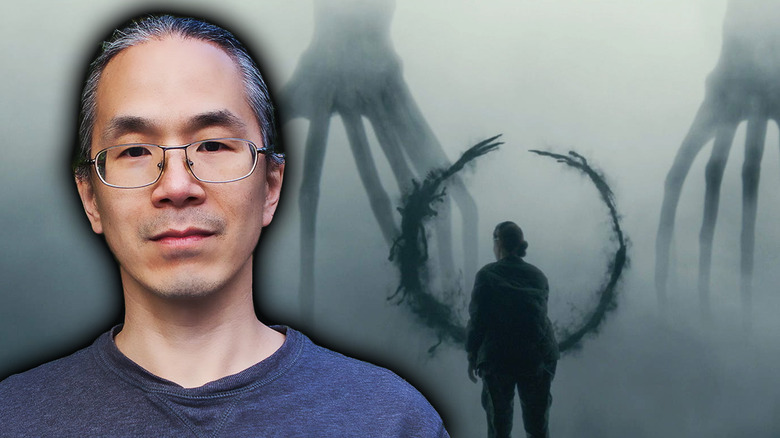
Penguin Random House / Paramount Pictures
To sci-fi fans, author Ted Chiang is known for a number of books, novellas, and short stories, ranging from 1990's Nebula-winning story "Tower of Babylon" to the 2019 Locus Award nominee "It's 2059, and the Rich Kids are Still Winning." He has written essays and commentaries for various outlets and publications, famously penning "Why A.I. Isn't Going to Make Art" for The New Yorker in 2024.
To cineastes, Chiang is best known for the 1998 short story "Story of Your Life," because it was adapted by screenwriter Eric Heisserer into the hit feature film "Arrival" in 2016. "Arrival" told the story of a linguist played by Amy Adams who was tasked with translating the ineffable language of a species of alien heptapods who had recently come to Earth under mysterious pretenses. She learned through her translations that the aliens experienced time differently than humans, and that their language was so reflective of that experience that it unlocked new methods of perception. "Arrival" was nominated for eight Academy Awards (including for its screenplay), while "Story of Your Life" was nominated for a Hugo Award and won a Nebula Award and a Theodore Sturgeon Award.
Of course, since one of his stories was adapted into a hit feature film, Ted Chiang has been asked about cinema a lot, even if it isn't his métier. Indeed, Chiang noted in a 2016 interview with Literary Hub that writing a screenplay adaptation sounds exhausting to him.
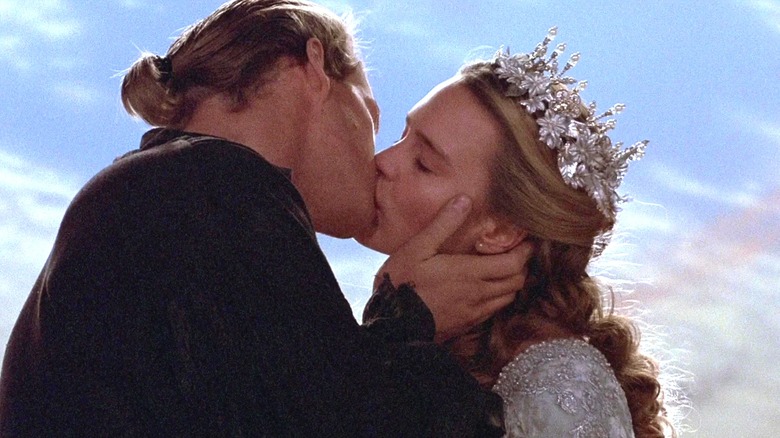
When it came to movies that captured the true essence of the literary works they might be adapting, though, Chiang knew exactly what movie nailed it: the screenplay for Rob Reiner's "The Princess Bride." That film was adapted to the screen by William Goldman, who also wrote the novel, and that movie, Chiang said, was spot-on.
Like everyone, Ted Chiang loves The Princess Bride
20th Century Fox
The original novel of "The Princess Bride" was a clever and arch piece of metafiction first published in 1973. Its full title was "The Princess Bride: S. Morgenstern's Classic Tale of True Love and High Adventure, The 'Good Parts' Version," presenting it as a novel within a novel, penned by the imaginary author S. Morgenstern. Goldman also offers active commentary on "Morgenstern's" text, similar to the way Vladimir Nabokov reviewed a poem by the fictional "John Shade" in his 1962 book "Pale Fire."
The story in both the novel of "The Princess Bride" and the Rob Reiner film adaptation follow the romance between a Renaissance-era farmer named Buttercup and her servant, Westley. When Westley is murdered by pirates while seeking a fortune, Buttercup becomes despondent and eventually becomes betrothed to the ambitious Prince Humperdinck. Worry not — Westley will return to rescue her. To adapt the metafiction element of the novel, Goldman added a modern-day grandfather character (played by the late, great Peter Falk) who read the S. Morgenstern book to his sick grandson (Fred Savage). These two characters would occasionally cut into the Renaissance fantasy romance to offer their 1987-era commentary.
When asked about what literature-to-film adaptations work the best, Ted Chiang was quick to mention Goldman's work, saying:
"I don't know if it's fair to count 'The Princess Bride,' because William Goldman wrote both the novel and the screenplay, but that's definitely an example of a great movie that captures the essence of the original story."
He's not wrong. When adapting, it's important to capture the essence of a story, rather than necessarily capture every element of its plot, or exact character details. Also, "The Princess Bride" is a great film regardless.
Ted Chiang admires anyone who can adapt a screenplay
Paramount
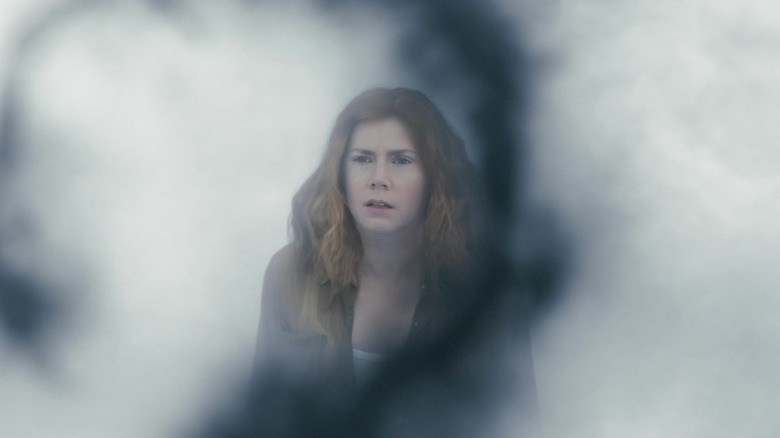
Adapting a book or short story into a screenplay was something Ted Chiang admitted that he wasn't capable of doing. Chiang was involved in the screenwriting process for "Arrival," albeit in an ancillary capacity. More than anything, he just gave his thumbs up to the drafts he was shown. But he seemed a little overwhelmed by the amount of writing that needs to go into a typical Hollywood screenplay:
"I read a couple of drafts of the screenplay and offered some feedback, and the screenwriter Eric Heisserer and I were in email contact. But I wasn't actively involved in the adaptation process, which I was fine with. I'm not a screenwriter, and the development process sounds exhausting. Eric has said that he wrote nearly a hundred drafts over the course of five years. Not all of those were major rewrites, but even so, that's a lot of revision. I'm glad he was willing to do that, because I certainly wouldn't have been."
Chiang also talked a little bit about visiting the set of "Arrival," but he didn't really know what was going on. For one, he wasn't allowed to see the design of the aliens or their spacecraft, as security was so tight. On one day, he said, there weren't any dialogue scenes, and on another, the film's director, Denis Villeneuve, only filmed one line of dialogue over and over. This is typical of any major film production, of course, but it's very difficult for a layperson to see how those fragments will eventually turn into a real movie.
Thankfully, Chiang loved the finished film of "Arrival."


 English (US) ·
  Indonesian (ID) ·