
 3 months ago
Static Media/DC Comics
We may receive a commission on purchases made from links.
Spoilers for "Absolute Batman" #21 to follow.
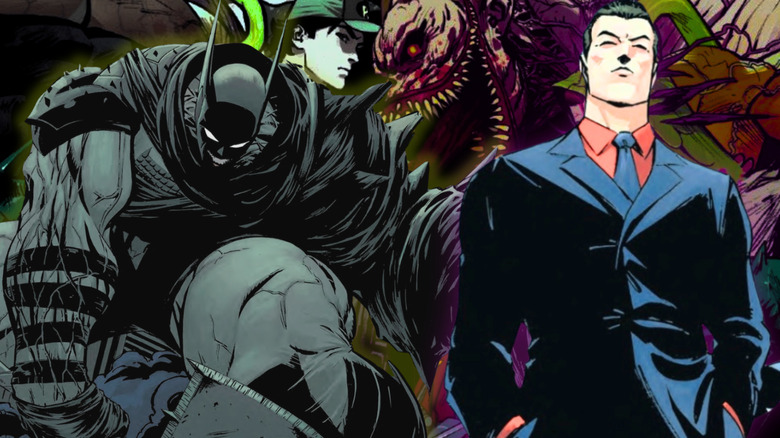
Writer Scott Snyder and artist Nick Dragotta redefined Bruce Wayne's origin right out of the gate in "Absolute Batman" issue #1, creating a Dark Knight "without the mansion, without the money, without the butler." That first issue's closing page completed the twist, revealing this universe's Joker — Jack Grimm (an immortal who's posed as Grimms I-V) — is one of the world's richest men.
Across the next 20 issues, Batman battled the Joker's forces, because Mr. Grimm's reach is wide and often invisible. The Caped Crusader defeated the "Party Animals" marauders that the Joker sent to ravage Gotham City, but Grimm hit back harder. Bruce also spent months trapped in the Joker's "Ark M" house of horrors beneath Gotham City, while Grimm's attack dog Bane mutilated Bruce's friends and nearly killed Batman himself. Most recently, Grimm's minion the Scarecrow pushed Jim Gordon to his death, framing Batman for the murder. In turn, Grimm's Robin squad was deputized to capture the "Cowled Prince of Crime."
Batman learned who the Joker is in "Absolute Batman" #15, the same issue in which Grimm himself came back to Gotham to get more hands-on battling Batman. The Caped Crusader has spent the last few issues observing Grimm, but the Joker has stuck to intermediaries in addressing Batman. But this is Batman and the Joker; they'd have to meet eventually. Now, in "Absolute Batman" #21, the promise made way back at the end of issue #1 is finally paid off.
After a night battling the Robins, Bruce is at work at his engineering job. Standing on the edge of an under-construction skyscraper, Bruce gets a visit from a project investor — Jack Grimm. Bruce is defiant, but he receives a terrifying message about how he has the Joker's undivided attention.
In Absolute Batman #21, the Joker finally introduces himself to Bruce Wayne
DC Comics
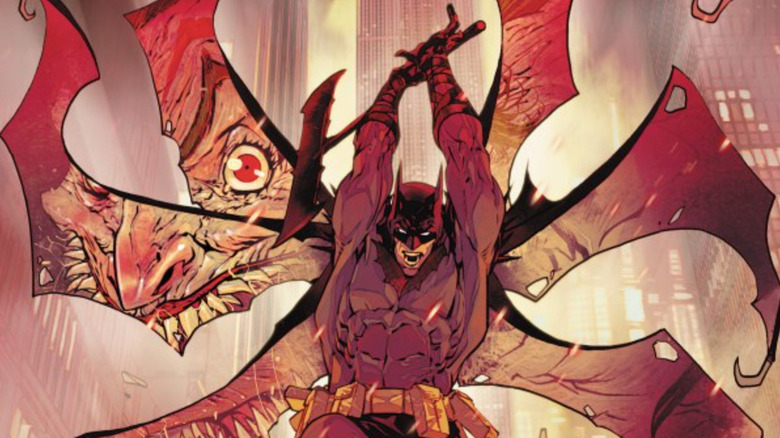
Bruce and the Joker's first meeting only runs four pages, and it's Grimm who does most of the talking. (Bruce yells "I know what you are" and "I'm not afraid of you," but the Joker isn't phased by either.) But with 21 issues of build-up, it's a strong culmination that lets us know the familiar Batman-Joker archenemy dynamic has set in.
On an aesthetic level, colorist Frank Martin does a strong job of infusing Joker-flourishes into Grimm's normal businessman appearance. His skin is a pinch too pale white, green and purple ink are used for highlights in his hair and coat, respectively, etc. Grimm's human form is also shorter than Bruce (who, granted, is 6' 9”), and he has to look up to meet his eyes. But we and Bruce both know Grimm isn't human. He flashes his true monstrous face and delivers the oldest prank there is to make Bruce jump: "Boo!"
Bruce almost falls to his death, but the Joker catches him. "If you hear one thing I say today, let it be this. Batman isn't yours to end. He's mine," Grimm says as he leaves. As always, the Joker doesn't want to kill Batman, because life without an equal and opposite nemesis is no fun. The earlier issues of this arc, "Absolute Batman" #19-20, have suggested Bruce's entire life — including becoming Batman — were a plot (a joke, even) of Grimm's. When he meets Bruce in #21, Grimm once more calls himself "the man who created [Batman]," and he couldn't be prouder:
"What you've become... I love it. The truth is, I can't imagine life without you anymore. You and me... I want to do this dance forever."
Absolute Batman once more leans on Christopher Nolan's The Dark Knight
Warner Bros. Pictures
"Absolute Batman" takes a lot after Scott Snyder's favorite ever comic, Frank Miller's "The Dark Knight Returns." But, occasionally, the comic shows influence from a different "Dark Knight" — Christopher Nolan's.
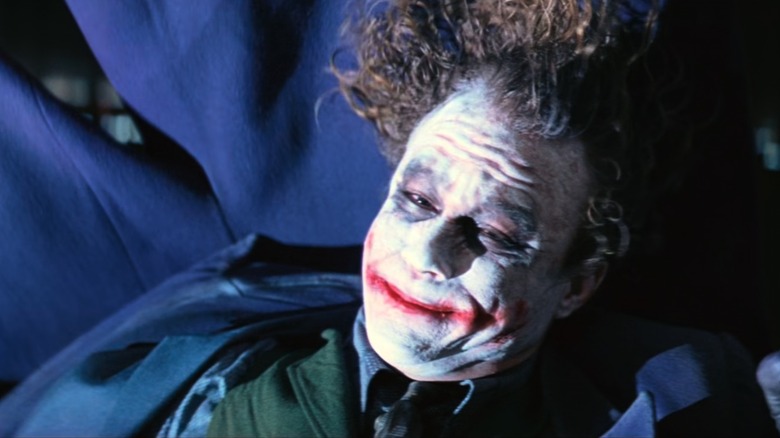
In "The Dark Knight," Heath Ledger's Joker is last seen hanging off an unfinished skyscraper. He almost fell to his death, but Christian Bale's Caped Crusader caught him. Joker joyously tells Batman that "[they're] destined to do this forever." Bruce and Grimm's first meeting in "Absolute Batman" #21 has the same setting and even similar dialogue about how Joker feels Batman "completes" him. Except, it's Bruce who falls off the skyscraper, and the Joker who saves him, because in the "Absolute" DC Universe, it's the Joker who (pardon the pun) holds the cards.
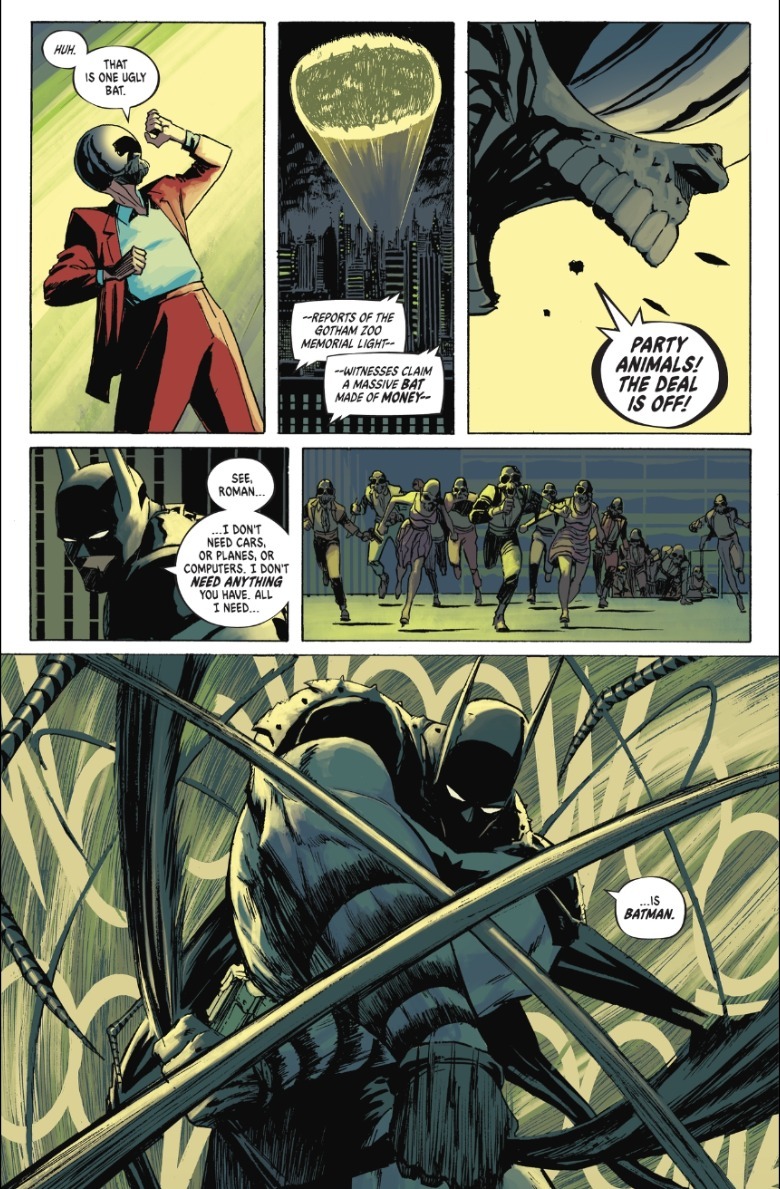
"Absolute Batman" previously paid a flipped homage to Nolan's "Dark Knight" like this in issue #5. Batman pretended to take a multi-million dollar bribe from the Party Animals. Then, he burned the money to light a Bat-signal in the sky, showing he's not for sale.
 DC Comics
Compare that to "The Dark Knight" when the Joker, a self-described "agent of chaos," sets fire to a pyramid-sized pile of mob money. In "Absolute Batman," the Joker instead represents the power and evil of concentrated wealth, which Batman must reject as corruptive. The 2025 one-shot "Absolute Evil" by Al Ewing and Giuseppe Camuncoli let Grimm monologue about his belief that there's a natural inequality to the world. Batman challenges this order, and Grimm notes with curiosity: "He didn't take the money."
Like classic Joker, Jack Grimm is fixated on Batman's unbreakable will, but it's less because Batman won't kill and more because Bruce can't be bought. "Absolute" Batman only wants to make the Joker's world burn.
"Absolute Batman" #1-21 are now available.


 English (US) ·
  Indonesian (ID) ·