
 5 hours ago
Universal Pictures
From Alfred Hitchcock's "Rope" to Sidney Lumet's "12 Angry Men," some of the best movies ever made have taken place in a single location. Limiting a film's scope in such a way is an extremely effective method for distilling the artform down to its most essential parts: character and storytelling. That's no different with Westerns.
Western movies have often taken advantage of America's incredible landscapes. From the genre defining Western (that barely impacted the box office) "The Big Trail" to the similarly decade-spanning tale of the Prescott family in "How the West Was Won," Western filmmakers have frequently made the land on which the United States was built as a big a character as the people themselves.
But some of the best Western films ever made have also unfolded on a much smaller scale — usually a frontier town where the clash between lawlessness and civilization can play out in microcosm. We've even seen Westerns confined to a single room. Regardless, placing limits like these on any film often brings out the best in its creators, and that's certainly been the case for this list of the best Westerns that take place in one location.
High Plains Drifter
Universal Pictures
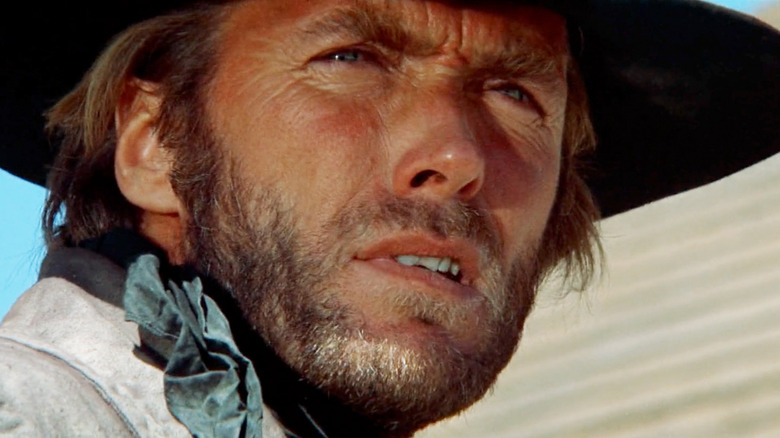
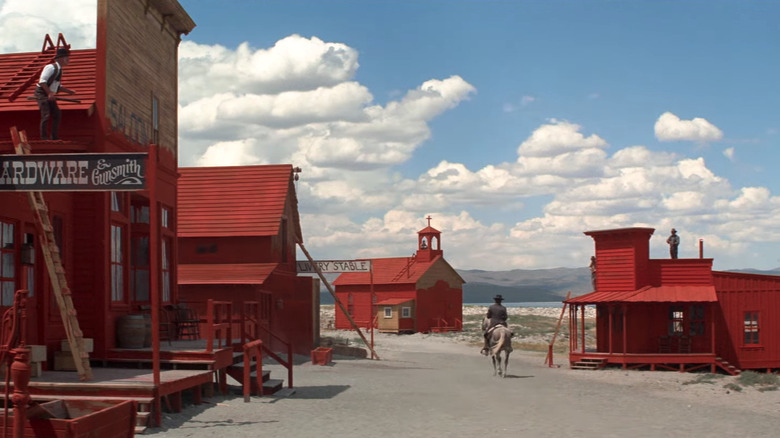
If you're going to make a movie set in one location, why not make it hell? That is, why not set it in a Western small town that may or may not be a physical manifestation of the underworld? The movie that prompted John Wayne to write an angry letter to Clint Eastwood was a fairly modest affair — at least in terms of its scope. 1973's "High Plains Drifter" sees Eastwood once again saddle up as a mysterious stranger. But this particular version of the Western archetype that Eastwood plays is less an anti-hero and more a manifestation of otherworldly retribution, who arrives in the town of Lago, ostensibly to protect its residents. In reality, he's there to make them pay for their sins.
One of many Westerns directed by Eastwood, "High Plains Drifter" is set almost entirely within Lago, where the townspeople allow outlaws to whip a U.S. Marshal to death. Eastwood's ghostly gunslinger then emerges from the surrounding desert embodying a cosmic fury as unforgiving as the parched plains from which he arrived. His order to paint every building in Lago red is designed as a way to depict the shame which covers the townspeople, and it's one of the most striking images in all of Eastwood's filmography.
Eastwood is no stranger to more grandiose depictions of the Old West. But "High Plains Drifter" proved he didn't need varied landscapes to produce a powerful Western. With just a morally compromised frontier town, Eastwood managed to further define the revisionist ethos that dominated Westerns of the 1970s, intentionally subverting the genre and upsetting old hands like the Duke in the process. Its status as one of the great Westerns of the 1970s has only grown, and rightly so.
The Hateful Eight
The Weinstein Company
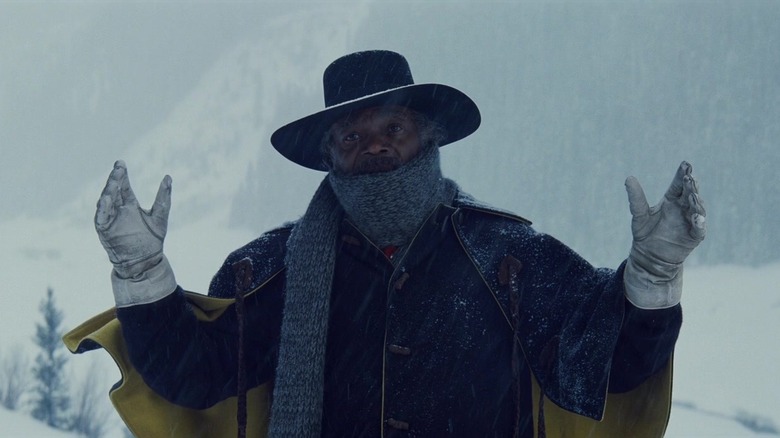
Quentin Tarantino took a big gamble making "The Hateful Eight," mainly because he shot it in inclement and unpredictable weather. But it was also somewhat of a gamble because it took place almost entirely in a small cabin and was nothing like Tarantino's previous Western, 2012's "Django Unchained."
The film focuses on eight strangers as they shelter from a blizzard in Minnie's Haberdashery, a stagecoach stopover in Wyoming. These aren't the societal archetypes who found themselves in similarly close quarters back in John Ford's "Stagecoach," however. This wretched octet comprises some of the nastiest individuals to ever roam the Old West. Unsurprisingly, trapping them in a small space for a couple hours results in a series of extremely selfish and violent acts.
"The Hateful Eight" doesn't always appear near the top of Tarantino film rankings. But the movie was never going to be bad considering its cast. Alongside frequent Tarantino collaborators and all-round Hollywood legends Samuel L. Jackson, Kurt Russell, Tim Roth, and Michael Madsen, the ensemble included Jennifer Jason Leigh, Walton Goggins, Demián Bichir, and Western veteran Bruce Dern — the man who shot down John Wayne himself back '72. What's more, "The Hateful Eight" earned three Academy Award nominations: Best Supporting Actress (Jennifer Jason Leigh), Best Cinematography, and Best Original Score, with legendary composer Ennio Morricone winning in the latter category. As such, "The Hateful Eight" is easily one of the best Westerns set in one location, and the only entry on this list to play out mostly in one small room.
The Man Who Shot LIberty Valance
Paramount Pictures
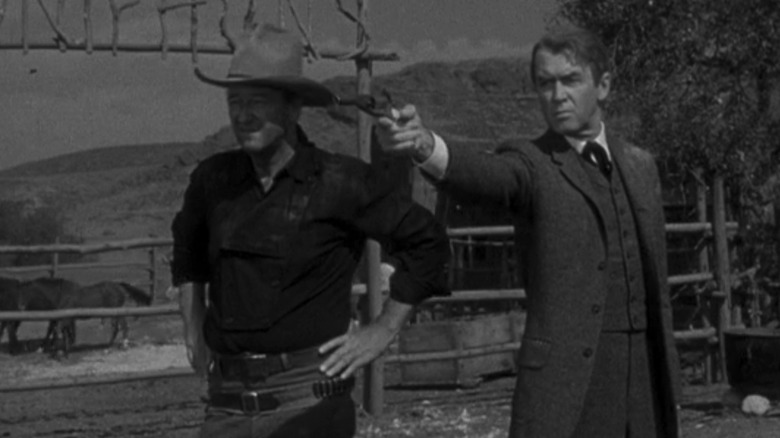
Directed by the great John Ford, who knew all too well the value of grouping characters together in a single space following his 1939 triumph "Stagecoach," "The Man Who Shot Liberty Valance" saw John Wayne and James Stewart collaborate on-screen for the first time. That alone ensured the film would fare well with audiences. But this now legendary Western was about more than the confluence of two major Hollywood careers.
It's significant that the town Shinbone — in which the film plays out — exists in an unnamed state. The town represents the frontier, which in the present day timeline of "The Man Who Shot Liberty Valance" has been transformed from a lawless land to a more civilized society. But as we discover near the end of the film, that transformation and the success of Stewart's Senator Ransom Stoddard has been built on a lie. Meanwhile, John Wayne's rancher Tom Doniphon is shown to have passed away at the very beginning, establishing a mournful, reflective tone to the film before it flashes back to tell its story of an outlaw felled by Doniphon's bullet and the man who took the credit. Ford appeared to be crafting a sober requiem for the Old West as he'd depicted it throughout his career, for which Shinbone and Wayne stood as symbols.
Interestingly enough, "The Man Who Shot Liberty Valance" was literally restricted location-wise, having been shot mostly on Paramount sound stages. That coupled with Ford's decision to film in black and white makes the feature feel confined in a way that serves to highlight the human drama and emphasize the sense of the frontier age coming to a close. Shame Ford otherwise made "The Man Who Shot Liberty Valance" miserable for everyone involved, though.
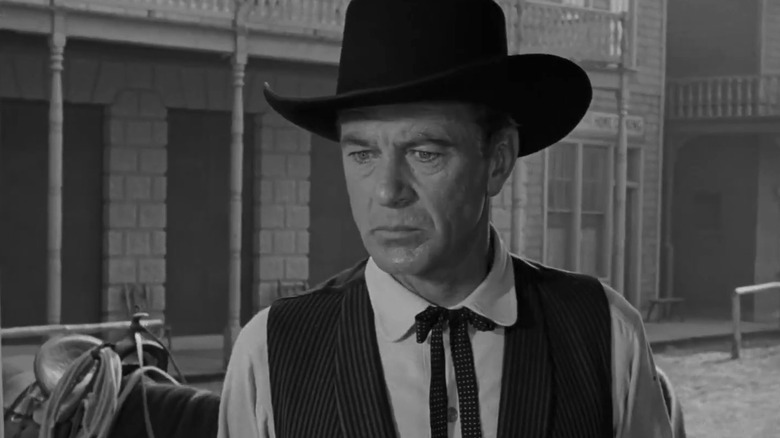
High Noon
United Artists
A revisionist Western everybody should watch at least once, "High Noon" tells the story of Gary Cooper's Marshal Will Kane, who's preparing to leave the frontier town of Hadleyville, New Mexico, with his new bride, Amy (Grace Kelly). When he learns that his former nemesis Frank Miller is on the loose and is headed for Hadleyville, Kane decides to stay and prepare for a confrontation. But this is not your typical Western hero. In fact, rather than facing down his outlaw enemies with the steely resolve of a classic Western gunfighter, he spends most of "High Noon" asking people for help. No such help is forthcoming, and Kane is forced into the final confrontation alone.
Howard Hawks and John Wayne made "Rio Bravo" out of hatred for "High Noon," perhaps predictably given the Duke would never dream of playing a man who gave the impression he needed help of any sort. But the film is considered one of the great Westerns — and all it took was one small town to create a masterpiece of tension and psychological drama.
More importantly, in director Fred Zinnemann's estimation, the town itself was crucial to the story being told. As he put it in his biography, "A Life in the Movies," (via Turner Classic Movies), "[Kane's] town – symbol of a democracy gone soft – faces a horrendous threat to its people's way of life." "High Noon" was about apathy and the loss of a collective belief in standing up for what's right. Like in so many Westerns before and after, then, the town at the center of "High Noon" functioned as a microcosm of society as a whole, and was all Zinnemann and co. needed to tell their story.
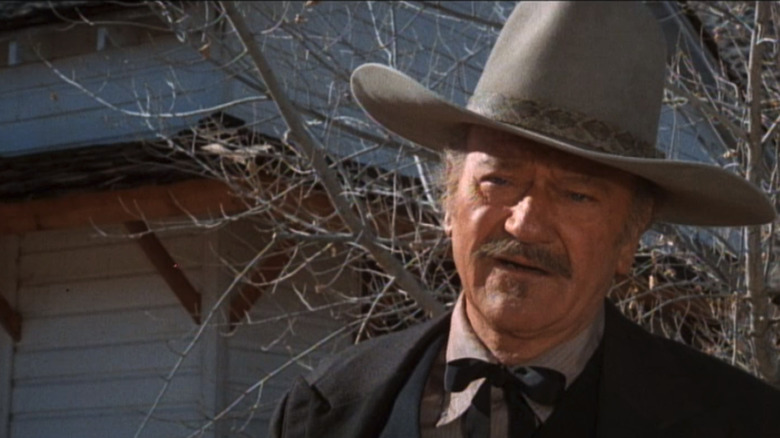
The Shootist
Paramount Pictures
Don Siegel's "The Shootist" bowed in 1976, at a time when the era of John Wayne was coming to a close in more ways than one. In a literal sense, the Duke only lasted three more years after the release of this film before he passed away from stomach cancer. In a figurative sense, the traditional big screen Western epitomized by Wayne was, at best, fading. More accurately, it had already been superseded by the revisionist Westerns of directors such as Sam Peckinpah and the man whom Wayne never liked to admit represented his successor, Clint Eastwood.
This story of an aging gunfighter learning he has terminal cancer plays out entirely in Carson City, Nevada. Here, Wayne's John Bernard "J. B." Books arrives and rents a room with Lauren Bacall's Bond Rogers and her son, Gillom Rogers (Ron Howard). Not wanting to die a slow, painful death as a result of his disease, Books arranges to meet three dangerous crack shots at a saloon, and is ultimately felled by a bartender's bullet. The final scene sees Gillom Rogers return the favor, shooting the bartender before tossing Books' gun and seemingly rejecting the notion of following in the footsteps of Wayne's shootist.
This entire story takes place within Carson City, where Books decides to spend his final days as both he and the Old West itself fade. "The Shootist" was Wayne's final film, and while many surely wished he went out with some sort of grandiose ode to both the country that birthed the Western and the genre that made him a star, this comparatively modest swan song, contained within the confines of Carson City, proved to be the perfect farewell.


 English (US) ·
 Indonesian (ID) ·