
 3 months ago

Morgan Creek Productions
One of the most celebrated figures in film criticism was the late, great Roger Ebert, who started writing movie reviews in the 1960s. Across a career that spanned nearly 40 years, Ebert naturally reviewed virtually every major science fiction movie that got a theatrical release during that time. This included sci-fi movies that received a perfect score from Ebert, several of which are widely recognized as enduring classics. However, not every movie in the genre was so lucky, and Ebert wasn't shy in letting his readers know which sci-fi films didn't impress him in the slightest.
This time around, we're focusing on the latter, which is to say the sci-fi movies that Ebert vocally disliked. While there were some movie reviews that Ebert was completely wrong about, for the most part, he's right on the money with many of his critical assessments here. For the purposes of this piece, we're including movies that Ebert scored with a one-star rating or less out of a possible five-star total.
These are the 10 worst sci-fi movies of all time, according to Roger Ebert through his published reviews.
Saturn 3
ITC Entertainment
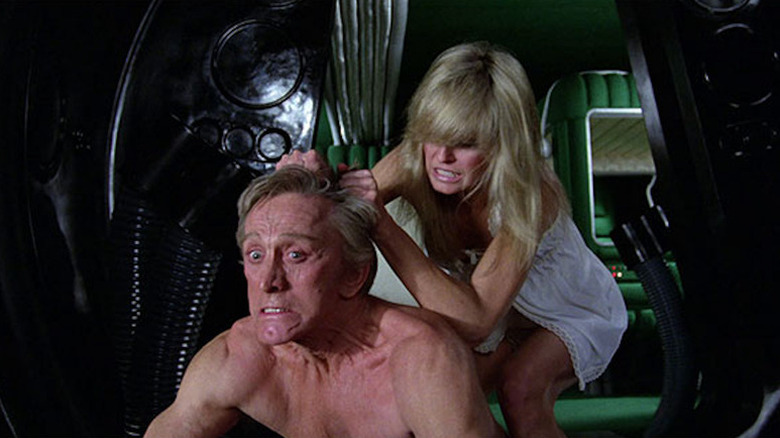
The British film "Saturn 3" is a Kirk Douglas sci-fi flop that Roger Ebert absolutely hated when it premiered in 1980. Douglas stars as Adam, a scientist on a remote research station with his colleague and much younger lover Alex (Farrah Fawcett). The couple is visited by the homicidally deranged Captain Benson (Harvey Keitel), who implants his murderous mental patterns into an android, placing everyone in danger. This leaves Alex and Adam to fend for themselves not only against Benson but his formidable robotic creation.
Giving "Saturn 3" a one-star review, Ebert unfavorably compared the movie to other sci-fi films with challenging themes, including "Silent Running" and "Close Encounters of the Third Kind." Repeatedly pointing out how unbelievably stupid the whole proceeding felt, Ebert derided virtually every major aspect of the movie. Referring to it as "the lowest common denominator of filmmaking," Ebert labels the film as being "awesomely stupid, totally implausible from a scientific viewpoint, and a shameful waste of money." A disappointing effort from all parties involved, one can't but agree with Ebert in the event that you do happen to subject yourself to a viewing of "Saturn 3."
Dune (1984)
Universal Pictures
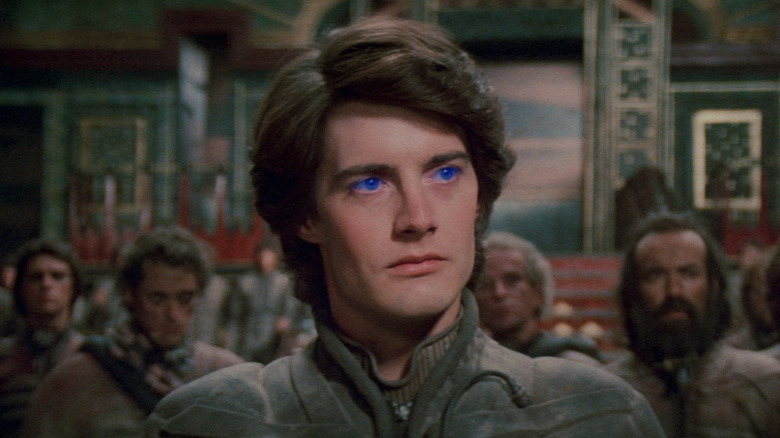
Though David Lynch's "Dune" is better than its reputation suggests, Roger Ebert was definitely not among its fans. The 1984 film adapts Frank Herbert's seminal sci-fi novel into a single 137-minute movie, as opposed to splitting it into two installments like filmmaker Denis Villeneuve's subsequent adaptations. This means everything from the betrayal of House Atreides on the desert planet of Arrakis to the revenge of Paul Atreides (Kyle MacLachlan) is condensed. Among the movie's more publicly sanguine critics was Ebert, who awarded the film one star in his review.
Ebert described the 1984 "Dune" as being "a real mess, an incomprehensible, ugly, unstructured, pointless excursion into the murkier realms of one of the most confusing screenplays of all time." This description came after noting that the movie bottomed out below his expectations within nine minutes of starting, eroding his hopes for another popcorn sci-fi experience. Ebert slammed the special effects, the cinematography, and claimed "nobody looks very happy in this movie" as an observation of its performances. Of all the movies that Ebert gave retrospectively more positive reviews, Lynch's "Dune" adaptation was not one of them.
Godzilla 1985
New World Pictures
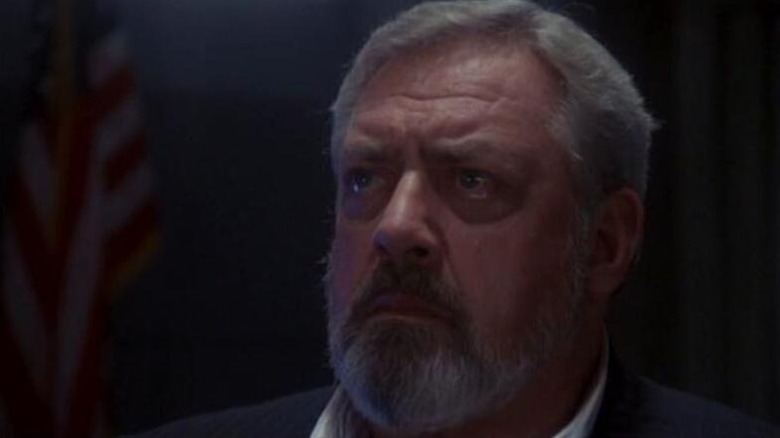
Just as "Godzilla, King of the Monsters" heavily reedited the 1954 "Godzilla" for American audiences, the franchise's soft 1984 reboot underwent a similarly overhauled localization. Retitled "Godzilla 1985" to reflect its North American release year, the movie stars Raymond Burr reprising his 1956 "King of the Monsters" role of Steve Martin. In this iteration of the 1984 movie, Martin is summoned to provide consulting support due to his presence in Godzilla's 1956 attack on Japan. This version of the story puts an additional emphasis on the Americans' role in the original incarnation of the narrative in 1984's "The Return of Godzilla."
In his one-star review of "Godzilla 1985," Ebert wrote that the movie couldn't even qualify under the "so bad, it's good scale" in terms of its entertainment value. Ebert derided the shoddy lip-syncing and editing, including a relatively lifeless performance from Burr to connect the movie to its 1956 predecessor. Interestingly, Ebert doesn't make note of the awkward localization attempts or an awareness of "The Return of Godzilla" at all, perhaps not knowing of its existence at the time. Just like the original movie, "The Return of Godzilla" deserved better treatment from its international distributors and Ebert at least recognizes the shoddy craftsmanship in the attempt.
Stargate
MGM
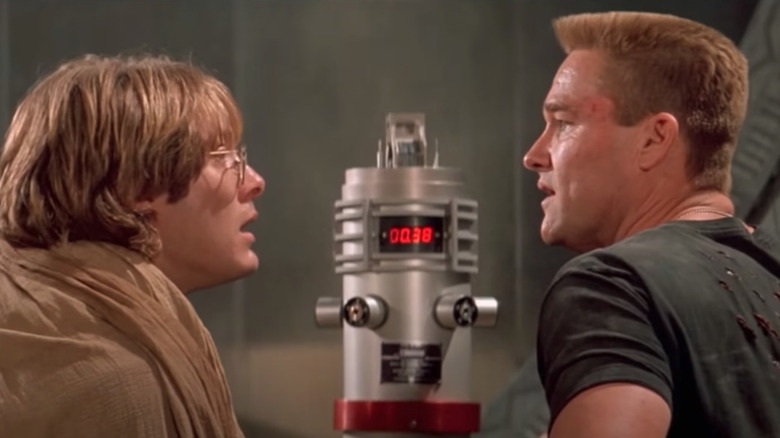
Even by his own lovingly unfiltered standards, Roger Ebert had an extremely harsh review for "Stargate," which held a particularly dubious distinction among his critiques. The 1994 movie has Egyptologist Daniel Jackson (James Spader) summoned by the military to decipher hieroglyphs on a strange ancient structure. Discovering the structure, a stargate, opens a wormhole to a faraway world, Jackson joins a small lead led by officer Jack O'Neil (Kurt Russell) to investigate. Jackson and O'Neil take on a humanoid alien who inspired the ancient Egyptian deity Ra (Jaye Davidson) in a battle for the fate of both worlds.
Ebert despised "Stargate" so much that he included it among his most hated films of all time list. Incensed by the story's leaps in logic, Ebert claimed that "Ed Wood," a movie about the reputed worst filmmaker of all time, was meant to prepare audiences for "Stargate." Elaborating further in his one-star review of the movie, Ebert explained that the film featured one of the weirdest plots ever conceived, mixed with action movie cliches. Ebert was flabbergasted by the mishmash and made his dissatisfaction with the clumsily handled end product clearly known.
Armageddon (1998)

Walt Disney Studios Motion Pictures
"Stargate" wasn't the only '90s sci-fi blockbuster to land on Ebert's most hated movies list, with 1998's "Armageddon" joining it. The Michael Bay film revolves around humanity learning an enormous asteroid is headed straight towards Earth in a possible extinction-level event. NASA trains a group of oil drillers to become astronauts and land on the asteroid to plant a nuclear device, destroying it and saving the planet. Despite the obviously preposterous premise, "Armageddon" became the biggest movie of 1998, though Ebert was still unimpressed in his own assessment.
Roger Ebert absolutely hated "Armageddon," and true to form and profession, he did not keep his feelings about it to himself. Giving the movie a one-star review, Ebert compared the movie to the equivalent of a 150-minute trailer rather than a substantial feature film. Ebert decried his viewing experience as sensory overload, and not in a complimentary way, with its dialogue full of nonsensical platitudes and uninspired cliches. Rather than subjecting one's self to "Armageddon," Ebert warned potential viewers that it was "worth more to get out," a disclaimer right in his opening paragraph.
Battlefield Earth

Morgan Creek Productions
It should come as no grand surprise that a movie as widely reviled as "Battlefield Earth" similarly failed to impress Roger Ebert, but his reaction is definitely worth mentioning. The 2000 movie, produced by and starring John Travolta, takes place in the year 3000, with Earth conquered and ruled by the extraterrestrial Psychlos for a millennium. Travolta stars as the villainous Psychlo security chief Terl, who decides to train the enslaved humans to mine gold in a bid to be reassigned away from Earth. This plan backfires when the humans that they train become intelligent enough to coordinate a successful rebellion against the Psychlo occupation.
"Battlefield Earth" haunted its screenwriter J.D. Shapiro for years, and seeing the caliber of movie carrying his name as a credited writer, his trauma is completely understandable. In his own review, Roger Ebert predicted the film would become the king of bad movie jokes, accurately anticipating its rampant notoriety. Awarding the movie a half-star score, Ebert compared his viewing as the cinematic equivalent of "taking a bus trip with someone who has needed a bath for a long time." An all-around slog of a film, full of laughably bad performances and more leaps in logic than one can keep count of, "Battlefield Earth" is a complete trainwreck.
Jason X
New Line Cinema
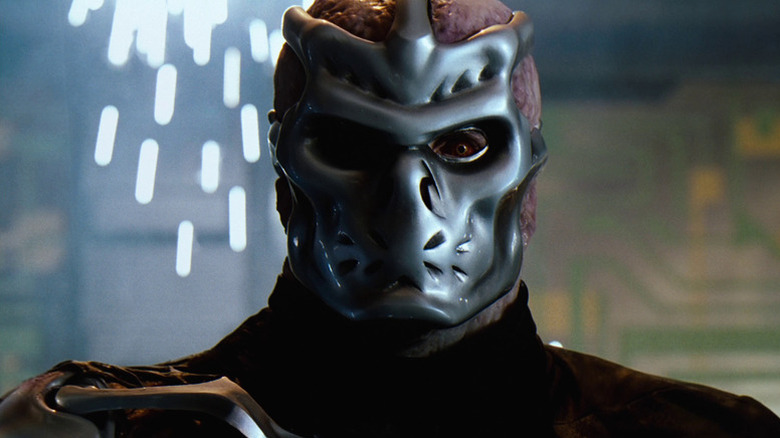
While the 2001 space horror movie "Jason X" has its defenders and apologists, Roger Ebert certainly wasn't one of them. The most gleefully ludicrous entry in the "Friday the 13th" film series, the movie has masked slasher Jason Voorhees revived on a 25th century spaceship. Immediately resuming his killing spree, Jason preys on a group of students and a small team of soldiers sent to stop him. This results in Jason becoming cybernetically upgraded, effectively making him deadlier than ever before as he stalks his victims in this futuristic environment.
"Jason X" is aware of how ridiculous its premise is, having fun with the possibilities of placing its titular killer in a sci-fi setting. Even with that in mind, Ebert was not impressed by the movie at all, awarding it a half-star rating in his review. In quoting one of the movie's characters, Ebert remarked that the movie "sucks on so many levels," as an accurate summation of its quality. Going as far as to compare the movie to Chernobyl due to its wide release date coincidentally sharing an anniversary with the nuclear disaster, Ebert detested the strange sci-fi slasher.
Death Race (2008)

Universal Pictures
A remake of "Death Race 2000" had been in various stages of development for sometime, finally released in 2008 as a soft reboot and prequel to the 1975 movie. Written, directed, and produced by filmmaker Paul W.S. Anderson, the movie stars Jason Statham as Jensen Ames, a man framed for his wife's murder. Ames is imprisoned in a private penitentiary which livestreams its inmates participating in a demolition derby with heavily modified cars. Finding the game not only rigged against but that the prison's warden arranged for his wife's murder, Ames sets out to get his revenge.
Roger Ebert hated the Jason Statham "Death Race" with a passion, another movie that he negatively regarded as a sensory overload. Repeatedly comparing the film to a video game, with its mindless action and lack of dramatic depth, Ebert awarded the 2008 movie a half-star review. This distinction is apparent right from Ebert's opening paragraph, commenting "Walking out, I had the impression I had just seen the video game and was still waiting for the movie." Less than impressed, Ebert dryly observed that "Death Race" was never a franchise that was a guarantee for greatness, something clear in its 2008 revival.
Transformers: Revenge of the Fallen

Paramount Pictures
Though he gave the 2007 "Transformers" movie a positive review, Roger Ebert grew to hate the billion-dollar sci-fi franchise. This distinction began with the series' 2009 sophomore entry, "Transformers: Revenge of the Fallen," which does rank lower among the Transformers movies, to be fair. The sequel revolves around the first Decepticon (Tony Todd) and his hidden history on Earth, revealed following the resurrection of Megatron (Hugo Weaving). This is coupled by college student Sam Witwicky (Shia LaBeouf) becoming involved once again after his contact with the Allspark implanted ancient knowledge in his mind.
Ebert advised prospective audiences to "go into the kitchen, cue up a male choir singing the music of hell, and get a kid to start banging pots and pans together." This, reasoned Ebert in his one-star review of "Transformers: Revenge of the Fallen," was the sensory equivalent of watching the movie without the ticket price. Dismissing the film as "a horrible experience of unbearable length," Ebert called the characters witless and the action sequences incomprehensible. Ebert was similarly bearish on Bay's subsequent sequels, but there's just something special about his well-articulated ire from "Revenge of the Fallen" that earns its place here.
Battle: Los Angeles

Sony Pictures Releasing
A big-budget B-movie that found a modest level of success upon its theatrical release in 2011, "Battle: Los Angeles" did not count Roger Ebert among its fans. The movie opens with an extraterrestrial invasion of Earth targeting major coastal cities around the globe. Among the soldiers helping the evacuation of Los Angeles is U.S. Marine Michael Nantz (Aaron Eckhart), with his own traumatic wartime experience. As Nantz's unit guides civilians to safety, he decides to take the fight to a nearby alien command vessel to repel the attack.
Roger Ebert gave "Battle: Los Angeles" a half-star review, labeling the movie an insult to the entire science fiction genre. Ebert slammed the movie's visual effects, especially its aliens, while comparing their vessels to a collection of cobbled-together garbage. This criticism spreads to the movie's action sequences themselves, with Ebert referring to them as shoddily edited and regarding them as an "assault on the attention span of a generation." A forgotten sci-fi movie that is best remembered for just how much Ebert despised it, "Battle: Los Angeles" earned one of last genre flicks he lambasted.







 English (US) ·
  Indonesian (ID) ·